Primemas Showcases CXL Memory Innovations for AI and HPC at FMS 2026
Primemas and Micron advance rack-scale pooled memory with the Abaco Project, while new CXL solutions target growing AI inference, HPC and data-centre memory demands.
Primemas Inc., a pioneer in next-generation AI memory system architectures and chiplet-based silicon, showcased its latest CXL memory innovations at the Future of Memory and Storage (FMS) 2026. At the event, the company highlighted the industry's most comprehensive CXL memory portfolio and its strategic collaboration with Micron on the Abaco Project, a rack-scale compute system with over 100TB of CXL-attached shared and pooled memory developed for the Department of Energy’s Pacific Northwest National Laboratory (PNNL) to power next-generation, large-scale scientific AI, HPC and data-intensive workloads. The Abaco Project is supported by DOE’s Office of Science, Advanced Scientific Computing Research program.
As datasets for AI and data-intensive workloads scale beyond the limits of traditional hardware, data centres are severely bottlenecked by static local memory limits. Primemas and Micron Technology are working together to address this fundamental infrastructure challenge by pioneering a new paradigm. Rather than forcing expensive server over-provisioning, the Abaco System Architecture transforms memory into a dynamic, rack-scale infrastructure layer, allowing advanced CPU and GPU compute clusters to seamlessly access hundreds of terabytes of pooled Micron DDR5 memory within a single rack.
Primemas CXL Add-In Cards and Controller Silicon: The Core Engine of the Abaco System Architecture
The Primemas CXL add-in card is a PCIe-based CXL memory expansion card with 14 or 16 RDIMM slots, supporting up to 3.5TB or 4TB of DRAM capacity, respectively, when populated with 256GB RDIMMs. These products, referred to as the PMA14 and PMA16, deliver up to four times the memory capacity per CXL port compared with conventional monolithic alternatives. The CXL add-in cards are scheduled for shipment to Micron in September, where they’ll be installed in the Abaco system racks to begin testing, qualification and benchmarking efforts.
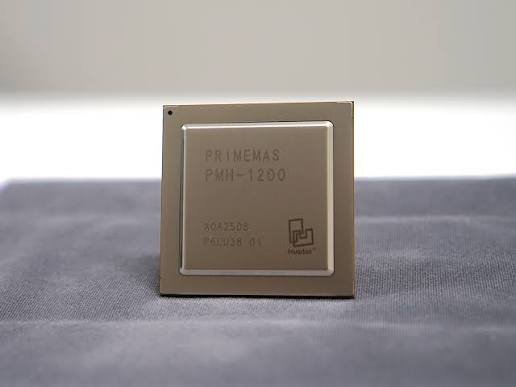
While the Abaco rack-based system architecture reflects a collaborative ecosystem integration between several companies, Primemas' advanced controller silicon provides the foundation that enables the architecture. This foundation is Primemas’ proprietary Hublet® architecture. Without Primemas’ high-density silicon capable of aggregating terabytes of DRAM, the high memory density required by PNNL’s advanced scientific AI workloads would not be achievable. Furthermore, by deploying three to four Abaco chassis per server rack, data centre operators can build shared memory pools exceeding 100TB, unlocking a new scale of memory infrastructure for AI, HPC, and data-intensive applications.
SLiM – Revolutionising AI Inference and KV Cache Offloading
While the Abaco Project demonstrates Primemem's ability to scale memory capacity for massive AI workloads, the company also unveiled SLiM (Switchless Pooled Memory), a breakthrough memory architecture designed for KV-cache-intensive AI inference workloads that demand both high capacity and ultra-high bandwidth. Designed as a space-efficient 1U system, SLiM expands KV-cache capacity and enables multiple servers to access tens of terabytes of shared DRAM with ultra-low latency, without the cost and complexity of external CXL switches.
Strategic Validation of the New AI Memory Era
“As AI and data-intensive workloads continue to drive unprecedented demand for memory, the industry needs new architectures that can scale memory capacity more efficiently across the data centre,” said Luis Ancajas, director of CXL product management and business development at Micron. “In collaboration with PNNL, the Department of Energy and ecosystem partners like Primemas, Micron is helping advance memory system architecture innovations to deliver critical enterprise and data centre-ready CXL solutions to the market.”
“PNNL's scientific AI and HPC workloads have memory footprints that no single server can satisfy, and over-provisioning every node is neither practical nor affordable,” said Sumit Puri, Co-Founder and CTO at Liqid. “Our collaboration with Primemas and Micron on Abaco pairs high-density CXL silicon and Micron DDR5 with Liqid's memory pooling solution and fabric management, so compute clusters can reach hundreds of terabytes of system memory as a single, orchestrated pool.”
“FMS 2026 validated a clear industry shift toward disaggregated and shared memory architectures, and Primemas is proud to be at the forefront of this transition," said Joseph Baco, VP of Business Development at Primemas. "The strong interest in our upcoming Abaco deployment at PNNL and our switchless SLiM solution demonstrates that data centres are actively seeking to overcome the limitations of traditional server architectures. The reception at FMS confirms that the industry is moving beyond static local memory toward a more flexible, efficient, and AI-optimized future.”
Building on this momentum, Primemas also highlighted its roadmap for intelligent memory systems, integrating CPU and FPGA acceleration capabilities directly within its proprietary Hublet® architecture to create advanced near-memory computing platforms for AI and database acceleration.