Ambiq Advances Edge AI Development with Open-Source heliaPROFILER for Apollo SoCs
11 August 2026 |
Interaction
New profiling tool gives developers greater visibility into AI performance, memory usage and energy efficiency, helping accelerate the development of production-ready Edge AI applications.
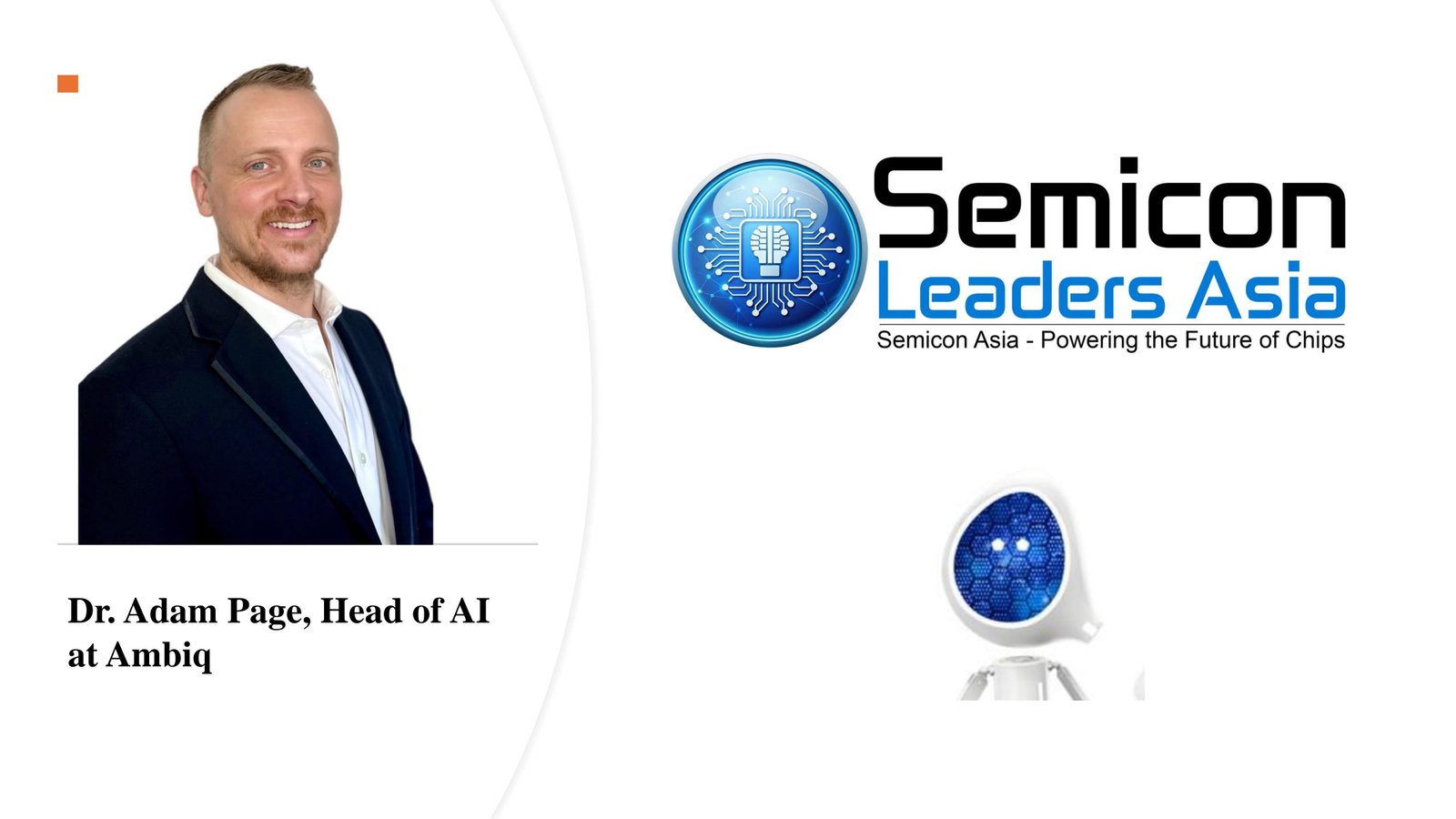
Semicon Leaders Asia Speaks with Dr Adam Page, Head of AI at Ambiq, on AI Workload Optimisation, Open-Source Edge AI and the HELIA Ecosystem
Q. heliaPROFILER is designed to simplify AI workload optimisation on resource-constrained devices. What specific challenges faced by edge AI developers does this new tool address, and how does it improve the development process?
The conversation around Edge AI has evolved significantly. A few years ago, the focus was largely on proving that AI could run efficiently on embedded devices. Today, developers are deploying increasingly sophisticated AI workloads in commercial products, where power, memory, and compute resources are tightly constrained. The challenge is no longer simply whether a model can run, but how efficiently it performs on the target device.
This makes optimisation a critical part of Edge AI development. Developers need visibility into how workloads actually execute on their hardware—where bottlenecks occur, how resources are used, and which optimisations will have the greatest impact. Without the right tools, this can become a highly iterative process that slows the transition from prototype to production.
heliaPROFILER is designed to simplify that process. As part of Ambiq’s HELIA™ Edge AI ecosystem, it provides developers with greater visibility into AI workload execution on Apollo SoCs, enabling them to evaluate performance on the hardware where their applications will ultimately run. This helps teams identify optimisation opportunities earlier and make more informed decisions about performance and resource trade-offs.
Just as importantly, heliaPROFILER makes it easier to incorporate profiling throughout the development cycle. As models and software evolve, developers can measure performance, validate improvements, and identify potential regressions without building their own profiling infrastructure.
Ultimately, Edge AI optimisation is becoming a system-level challenge. Developers must balance AI capability, responsiveness and energy efficiency within the practical limits of embedded hardware. heliaPROFILER helps make that optimisation process more visible and repeatable, accelerating the path from a working AI model to an efficient, production-ready product.
Q. Ambiq has made heliaPROFILER open source from launch. What role does an open-source strategy play in expanding the HELIA AI ecosystem and encouraging wider adoption of your Apollo platform?
Open source has played an important role in accelerating AI innovation by enabling developers to build on shared tools, adapt them to their needs, and contribute improvements back to the community. We believe the same collaborative approach is increasingly important for Edge AI.
Launching heliaPROFILER as open source reflects our goal of building HELIA™ as an accessible, developer-focused AI ecosystem. Embedded development environments are rarely one-size-fits-all. Engineering teams often use customised toolchains, workflows, and deployment processes, so giving developers access to the source code provides greater flexibility to integrate profiling into the way they already work.
Openness also creates opportunities for broader participation. Developers, researchers, and ecosystem partners can examine how the tool works, provide feedback, and potentially contribute enhancements. Over time, that collaboration can help strengthen the tools available to the wider Edge AI community and allow HELIA to evolve alongside changing AI workloads and development requirements.
There is also a practical benefit for developers evaluating Ambiq’s Apollo platform. An open profiling tool provides teams with a transparent way to assess how their AI workloads perform on Apollo SoCs and to explore the impact of different optimisation approaches. Rather than relying solely on specifications or theoretical benchmarks, developers can evaluate the platform using workloads relevant to their applications.
Ultimately, we see open source as a way to reduce friction between evaluation and development. By making it easier for developers to understand, integrate, and build on the tools in the HELIA ecosystem, we can encourage broader experimentation and help more teams move efficiently toward production-ready Edge AI applications on Apollo.
Q. With heliaPROFILER joining heliaCORE, heliaRT and heliaAOT, how does this addition strengthen Ambiq's end-to-end software offering and differentiate the company in the rapidly growing edge AI market?
As Edge AI moves from experimentation to commercial deployment, developers increasingly need more than efficient silicon or individual optimisation tools. They need a software environment that supports them from model development through optimisation, deployment and performance validation, while meeting tight constraints on power, memory and compute resources.
That is the role of the HELIA™ AI ecosystem. heliaCORE, heliaRT, and heliaAOT provide complementary capabilities that help developers optimise and deploy AI workloads efficiently on Ambiq’s Apollo platform. With the addition of heliaPROFILER, developers also gain greater visibility into how those workloads perform on the target hardware.
That visibility closes an important part of the development loop. Developers can measure workload behaviour, identify bottlenecks and evaluate the impact of different optimisation approaches using real-world performance data. Profiling can therefore become part of an ongoing development process—helping teams optimise, measure and refine their applications as models and software evolve.
This is increasingly important because Edge AI performance depends on more than the neural network alone. The interaction among the model, runtime, compiler, memory system, and underlying silicon all influences the efficiency of the final application. Bringing these elements together in a more integrated development environment can help customers reduce complexity and move more confidently toward production.
We believe that combination is a key differentiator for Ambiq. Our focus is not only on delivering highly energy-efficient silicon but also on providing the software capabilities developers need to make effective use of that hardware. As Edge AI workloads become more sophisticated, tightly integrating efficient hardware with an end-to-end AI software ecosystem will be critical to enabling intelligent, responsive, and energy-efficient edge devices.
Q. Energy efficiency remains a key requirement for always-on AI devices. How does heliaPROFILER help developers balance AI performance, memory usage and power consumption for commercial deployments?
Always-on AI requires developers to balance competing priorities. Products need to deliver increasingly capable and responsive AI experiences while operating within strict limits on memory, compute resources and energy consumption. Improving one aspect of the system can affect another, so optimisation is ultimately about finding the right balance for a specific application.
That requires visibility into how AI workloads actually behave on the target hardware. heliaPROFILER helps developers understand workload execution on Ambiq’s Apollo platform, making it easier to identify bottlenecks and evaluate the impact of different optimisation decisions. Rather than optimising individual metrics in isolation, teams can use profiling data to make more informed choices about how best to use the available compute and memory resources.
This is particularly important for always-on applications, where even relatively small inefficiencies can have a meaningful impact over extended periods of operation. Understanding where processing time and system resources are being consumed allows developers to focus their optimization efforts where they can deliver the greatest benefit.
heliaPROFILER also makes profiling a repeatable part of the development process. As models, software and application requirements evolve, teams can continue to measure workload behaviour, validate improvements and identify performance regressions earlier in the development cycle.
Ultimately, energy-efficient Edge AI is not about maximising AI performance at any cost. It is about delivering the right level of intelligence and responsiveness within the power and resource budget of the product. By giving developers greater visibility into workload behaviour on Apollo hardware, heliaPROFILER helps them make the engineering trade-offs required to move from an AI prototype to an efficient, production-ready implementation.
Q. Edge AI adoption is accelerating across sectors such as wearables, healthcare, industrial automation and smart consumer devices. Which application areas do you believe will benefit most from this new profiling capability?
The applications that stand to benefit most are those where increasingly sophisticated AI must operate within very constrained power, memory and compute budgets. In those environments, even small improvements in workload efficiency can meaningfully improve battery life, responsiveness and overall product performance.
Wearables are a particularly strong example. Devices are evolving beyond basic activity tracking to support advanced health monitoring, contextual awareness, voice interfaces and personalised experiences. At the same time, they must remain small, responsive and capable of operating for extended periods on limited battery life. Profiling helps developers identify where AI workloads consume resources and where optimisation can deliver the greatest benefit.
Similar considerations apply to healthcare and wellness devices. As more intelligence moves directly to endpoints, developers need to optimise increasingly capable workloads while maintaining the efficiency and responsiveness required for continuous or frequent operation.
Industrial applications are another important area. AI is increasingly deployed close to equipment for condition monitoring, predictive maintenance, and other forms of intelligent sensing. These systems may operate continuously for extended periods, making efficient use of compute and memory resources especially important.
The same principle applies to smart home products, asset tracking, environmental sensing, and other intelligent IoT devices. What connects these applications is less the specific AI model than the need to extract as much useful intelligence as possible from resource-constrained hardware.
As Edge AI adoption grows, we expect profiling to become a routine part of development. The ability to understand how workloads behave on target hardware and to continuously refine their efficiency will be increasingly important for turning promising AI capabilities into commercially viable products.
Q. Looking ahead, how does heliaPROFILER fit into Ambiq's broader roadmap for edge AI, and what additional capabilities or ecosystem partnerships can developers expect in future HELIA platform releases?
heliaPROFILER is an important part of our broader vision for HELIA™: making Edge AI development more measurable, integrated, and easier to move from experimentation to production. As models become more sophisticated, developers will need increasingly sophisticated tools not only to deploy AI but also to understand how efficiently those workloads use the underlying hardware.
Profiling therefore becomes an important feedback loop within the HELIA ecosystem. Developers can optimise a workload, deploy it on Apollo hardware, measure its behaviour, and use those results to guide the next iteration. Over time, we see that the tighter connection between optimisation, deployment, and measurement is becoming increasingly important as Edge AI applications grow in complexity.
heliaPROFILER itself will continue to evolve. Our near-term focus includes broadening platform and execution-engine coverage as we move toward a stable 1.0 release, while continuing to improve the developer experience and the insights from on-device profiling.
More broadly, our HELIA roadmap is centred on reducing friction across the Edge AI development lifecycle. That means continuing to strengthen our software tools, supporting the AI frameworks developers already use, and improving interoperability across the embedded AI ecosystem. Partnerships and integrations will play an important role in that strategy because developers increasingly expect hardware, software frameworks, development tools, and measurement technologies to work together rather than exist as isolated solutions.
Our objective is straightforward: to give developers a more complete path from AI model to an efficient commercial product. By continuing to advance HELIA alongside the Apollo platform, we aim to help customers deploy increasingly capable AI while staying within the power, memory and cost constraints that define intelligence at the edge.