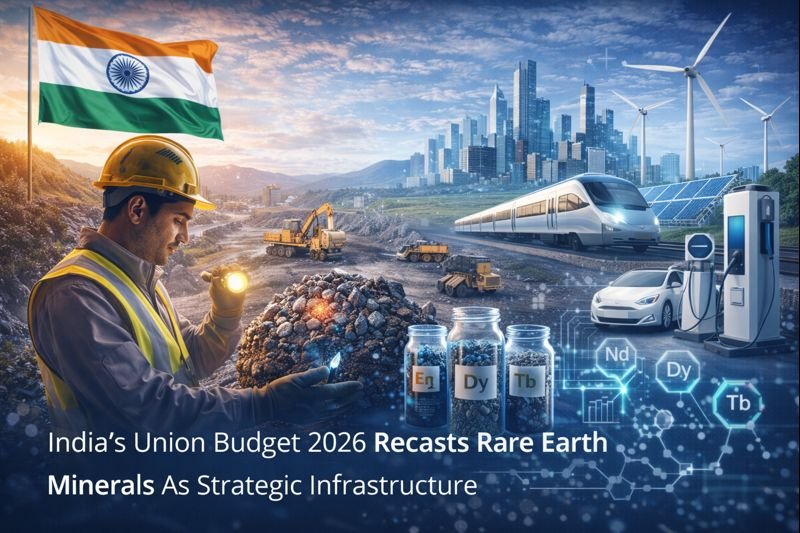
India’s Union Budget 2026 places rare earth minerals firmly within the country’s strategic materials and supply chain security agenda. While rare earths do not feature as a standalone headline announcement, their importance is clearly embedded across priorities spanning mining reform, clean energy, electronics manufacturing and advanced industrial development. The approach reflects intent rather than optics, positioning rare earths as enabling infrastructure for future technologies rather than a commodity in isolation.
Reframing Rare Earths As Strategic Assets
The Budget reinforces policy backing for the exploration and development of critical and strategic minerals, explicitly including rare earth elements essential to semiconductors, electric mobility, renewable energy systems and defence technologies. This framing aligns rare earths with India’s broader objectives of industrial resilience and technology sovereignty. The message to industry is clear rare earth availability is no longer viewed as a supply side issue but as a national capability imperative.
Accelerating Domestic Exploration And Mining
Enhanced support for geological exploration and mining reforms aims to unlock domestic rare earth bearing resources at scale. By prioritising discovery and extraction within India, the Budget seeks to reduce structural import dependence, particularly in materials that underpin electronics manufacturing and the energy transition. For investors, this improves long term resource visibility and reduces geopolitical exposure embedded in existing global supply chains.
Shifting The Value Equation Through Processing And Refining
One of the most consequential signals in the Budget is the emphasis on downstream processing and value addition. In the rare earth ecosystem, global vulnerabilities are concentrated not in mining alone but in separation, refining and magnet manufacturing. India’s focus on building these capabilities domestically indicates an ambition to move higher up the value chain rather than remain a supplier of raw materials.
For global companies, this marks a strategic opportunity to co build processing and refining capacity in an emerging alternative hub.
Public Sector As Anchor With Space For Global Capital
The continued positioning of public sector enterprises as anchors in rare earth development provides scale, policy continuity and execution confidence. At the same time, regulatory clarity and investment incentives are designed to attract private and foreign participation. This hybrid model closely mirrors India’s semiconductor strategy using state support to de risk early stages while enabling global collaboration and capital inflow.
Demand Side Integration Strengthens Commercial Viability
Rare earths receive indirect but powerful support through increased policy and budgetary backing for EVs, renewable energy, electronics manufacturing and advanced industrial platforms. This demand side visibility strengthens the commercial logic for investments across the rare earth value chain, from extraction and separation to alloy and magnet production.
By aligning supply development with domestic demand growth, India reduces the risk of stranded capacity and improves investment sustainability.
Why This Matters Globally
Global rare earth supply chains remain highly concentrated and geopolitically sensitive. Against this backdrop, India’s Union Budget 2026 signals a clear ambition to emerge as a reliable alternative sourcing and processing destination. The positioning of rare earths as strategic infrastructure rather than a cyclical commodity resonates strongly with global manufacturers seeking diversified, trusted supply chains.
The Union Budget 2026 embeds rare earth minerals into India’s long term industrial and technology strategy. Through coordinated support for exploration, processing, public private collaboration and integration with high growth sectors, India is laying the foundation to play a more consequential role in global rare earth supply chains. For global manufacturers and investors, the message is subtle but decisive India intends to be a participant of substance, not a peripheral supplier, in the materials that will define the next phase of technological growth.