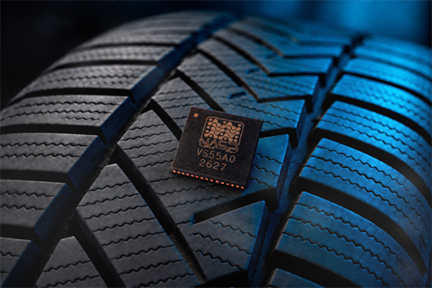
POLYN Advances VibroSense TMS Chip for Real-Time Tyre-Road Friction Detection
The neuromorphic analogue signal-processing chip enables AI-powered tyre sensors to provide real-time road-grip data for braking, stability control, ADAS and autonomous driving systems.
POLYN Technology, developer of innovative application-specific neuromorphic analogue signal-processing (NASP™) chips, announced a major milestone in the rollout of its VibroSense TMS solution, which tests have already shown enhances vehicle safety through improved braking.
The VibroSense TMS engineering chip, the integrated circuit for tire-road friction detection, is being delivered for assembly of AI-enabled tyre pressure management system (TPMS) sensor nodes. Potential customers – tyre manufacturers, vehicle OEMs, chassis system suppliers, advanced driver assistance system (ADAS) providers, and autonomous driving control providers – can begin evaluating the enhanced TPMS nodes immediately.
When a tire-mounted sensor node with the VibroSense chip is installed in a tyre, it analyses raw accelerometer data and accurately estimates the peak friction coefficient (PFC) of the ever-changing road surfaces under each wheel. The resulting values are wirelessly delivered to a vehicle’s ECU as a standard sensor signal. Then, braking, electronic stability control, all-wheel drive functions, autonomous driving, and other systems can leverage this information. No mechanical changes to the vehicle are required to obtain vital road-grip information.
“A road may look fine, but it isn't,” said Aleksandr Timofeev, founder and CEO of POLYN. “Today's braking, stability, and driver-assistance systems discover this the same way the driver does, when the wheel is already slipping. Tire-road friction is the last major input in vehicle dynamics that no sensor measures directly. VibroSense TMS changes that.”
Timofeev added that AI processing of accelerometer data inside a rotating tyre was long considered impractical for a mass-market device. However, “we built the most advanced NASP chip to date to do exactly that. For the first time, the car will know what the tyre knows."
In a recent third-party test, a vehicle equipped with VibroSense TMS in its tires reduced its stopping distance by 12 percent. Braking from 40 kilometers per hour (25 mph) on wet basalt pavement, the vehicle came to a full stop in 55.5 meters (182 feet). Without VibroSense TMS, the stopping distance was 63.2 meters (207 feet). VibroSense TMS reduced the stopping distance by more than one full car length, a critical distance in an emergency braking situation.
VibroSense TMS technology can be used by any tire brand, requiring only simple calibration for each new tire protector type to assess its unique vibration signature.
“For tyre manufacturers, ADAS companies, and automotive OEMs, VibroSense TMS has the potential to be an always-on source of information about real-time road-tire interaction at any given moment. This opens new opportunities for these companies to improve their safety functions, removing uncertainty in some situations and enabling faster decisions by smart vehicle systems,” Timofeev said.
POLYN’s timeline calls for tapeout of a commercially available chip in mid-2027, followed by automotive qualification.