HP and Infinity Double AI Inference Throughput on NVIDIA GB300 Platform
The collaboration optimised NVIDIA Nemotron 3 Super performance on the HP ZGX Fury, doubling concurrent workloads and token throughput without changing the underlying hardware.
Infinity (Infinity Artificial Intelligence Institute), an automated AI research company building the software layer that makes any AI chip inference-ready, announced a collaboration with HP Inc. Infinity and HP have been working together to use Infinity Auto Research to optimize the NVIDIA Nemotron 3 Super model running on the HP ZGX Fury powered by NVIDIA GB300 Grace Blackwell Ultra Desktop Superchip. The teams doubled concurrent workloads and doubled overall token throughput on the tested GB300 configuration without changing the underlying hardware.
“HP is focused on helping customers deploy AI at scale with solutions that combine powerful local AI devices and real-world productivity gains,” said Jim Nottingham, SVP and Division President, Advanced Compute Solutions, HP Inc. “Our collaboration with Infinity highlights how HP ZGX Fury can deliver greater efficiency, support more concurrent AI workloads, and help organizations maximize the return on their AI investments.”
In the tested configuration, the teams demonstrated support for approximately 2X concurrent requests at the same defined responsiveness threshold, increasing the amount of AI work that can be served from the same hardware. Infinity delivered the initial performance gain in under 24 hours of engineering work, with throughput optimization work continuing since.
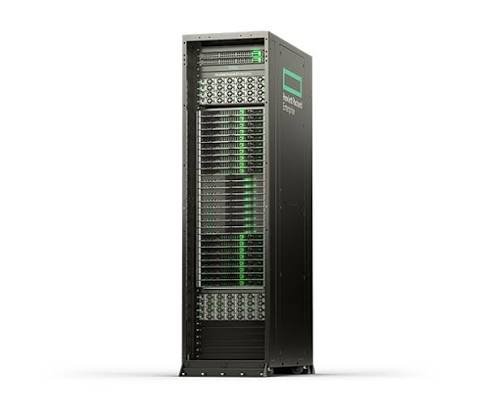
The collaboration centers on HP’s newest Z AI station, HP ZGX Fury, based on the NVIDIA DGX Station platform. Offering shareable AI compute with a rack-mountable, office-deployable design, the AI station enables multiple users to run inference simultaneously or developer teams to experiment and fine-tune in parallel on a single ZGX Fury.
“Infinity’s collaboration with HP highlights the transformative potential of workload-specific auto-research optimization on cutting-edge high-performance AI devices,” said Jeremy Nixon, founder and CEO of Infinity. “By integrating NVIDIA’s GB300 accelerated computing with HP ZGX Fury and Infinity’s optimization technology, we are pioneering ways for organizations to maximize AI workloads on the infrastructure they already deploy. The next frontier in AI is about extracting the greatest performance from every chip in use, and HP is moving swiftly to ensure their customers lead the way.”
Infinity's engineering team built optimizations across the inference stack, drawing on techniques used in vLLM, NVIDIA TensorRT-LLM and SGLang alongside its own proprietary work, to increase concurrency without degrading per-user responsiveness. The HP result builds on Infinity's published work surpassing vLLM.(2) Infinity's “infy” optimization system previously generated an inference engine from scratch for Qwen3-8B that delivered up to 34.3% more tokens per second than vLLM on identical hardware and parameters. Infinity previously demonstrated a related approach in a public case study with chip partner d-Matrix, reaching 92% of a new chip's theoretical peak performance within 10 hours of first hardware access.
The timing tracks a broader shift in enterprise AI spending. Gartner forecasts that worldwide spending on AI-optimized cloud infrastructure will grow 96% in 2026 to reach $42B and that global spending on AI inference will overtake spending on AI training for the first time this year (23.3B vs. $19B), as agentic AI's multistep, autonomous execution drives compute intensity higher. As inference becomes a larger share of AI infrastructure spending, improving the utilization and performance of deployed AI infrastructure becomes increasingly important for organizations scaling production AI.