How AlpSemi Is Reinventing Power Semiconductors for Solid-State Circuit Breakers
26 October 2026 |
Feature
As electrification accelerates, power infrastructure faces growing demands for safety, efficiency and intelligent power management. Yet circuit breakers, essential to protecting electrical systems, still largely rely on electromechanical technologies that have changed relatively little over decades.
AlpSemi aims to transform this landscape by developing advanced power semiconductor devices specifically designed for solid-state circuit breakers (SSCBs). This approach addresses a key challenge: improving the efficiency, compactness and cost competitiveness of semiconductor-based protection.
Founded in 2024 by Frédéric Dupont and Fabrice Letertre, both former executives at Soitec, a specialist in advanced materials, AlpSemi builds on deep industry expertise. The two founders also co-founded Exagan, a pioneer in gallium nitride (GaN) transistor technology, which was acquired by STMicroelectronics in 2020.
Rethinking electrical protection
Conventional circuit breakers use mechanical contacts to interrupt current when a fault occurs. SSCBs replace this mechanism with power semiconductor devices, such as transistors, enabling much faster electronic interruption.
Solid-state protection can interrupt fault currents up to 1,000 times faster than conventional mechanical solutions. As a consequence, it enables a 99,5% reduction of energy release during a short-circuit. By eliminating mechanical contacts as the primary switching mechanism, SSCBs can also avoid contact wear and reduce the risks associated with electrical arcing.
Their advantages extend beyond protection. Semiconductor-based breakers enable continuous monitoring of electrical parameters, including current and temperature, opening the way to more intelligent energy management and predictive diagnostics. All of these functions can be integrated into a single device. This creates a major architectural shift: fewer discrete components, simplified system architecture, and reduced integration complexity,
While the SiC / GaN industry has spent the last decade focused on materials innovation for AC/DC and DC/DC power conversion, every attempt to build an SSCB at scale using best-in-class devices has failed. Not because technology doesn’t work, but because the energy efficiency and economics collapse. That is why materials innovation alone is not enough and must be vertically integrated: device-level and system-level disruption are both required to ensure the industrial scalability of Solid-State Circuit Breakers.
Unlike conventional power semiconductors developed for conversion, AlpSemi switches are engineered from the ground up for solid-state circuit protection. This means optimizing the device from the outset for the parameters that matter most in SSCBs. Thanks to collaborations with industrial partners such as Schneider Electric, the technology is designed to meet the requirements of electrical distribution systems. It combines rapid fault interruption with low conduction losses, effective thermal management, compact integration and competitive costs.
Beyond silicon: Exploring advanced semiconductor materials
The performance of a solid-state circuit breaker depends heavily on its power semiconductor. The device must conduct current efficiently under normal operating conditions while responding extremely rapidly when a fault occurs.
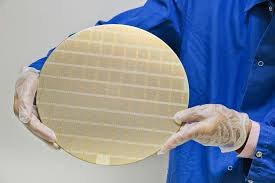
AlpSemi has chosen to develop transistor solutions based on Wide Bandgap, and Ultra Wide Bandgap materials as part of its longer-term technology strategy.
These materials hold tremendous potential for the future of power electronics. AlpSemi is working to harness their unique properties to develop innovative, reliable and cost-effective semiconductor solutions suited to industrial-scale manufacturing.
AlpSemi's approach combines materials expertise, semiconductor device design and system-level optimization to develop purpose-built technologies capable of delivering higher performance while making SSCBs more commercially viable.
AS800: the very first step of a global roadmap built around progressive new applications
AlpSemi's first product, the AS800, is purpose-built for Miniature Circuit Breakers (MCB). It is designed for 110VAC and 230VAC residential and commercial applications.
Legacy protection technologies - electromechanical circuit breakers - were designed for a world defined by predictable, centralized, and unidirectional AC power flows. Today buildings are becoming energy hubs, integrating increasingly dynamic electrical loads: bidirectional EV charging and on-site solar generation for instance.
This creates a new level of complexity for power distribution. As a result, buildings’ protection systems must become faster, more precise and more intelligent to detect and interrupt faults in microseconds, while also providing real-time monitoring and digital, software-defined control.
This is exactly the market need AlpSemi is addressing with the AS800, which combines ultra-low conduction losses, high current density and extreme compactness.
AlpSemi is already working on future release of more advanced version AS800 designed for bidirectional current interruption which will significantly reduce the number of semiconductor switches required while reducing conduction losses and system footprint. Bidirectional power switches provide significant benefits for both AC and DC electrical systems.
In AC applications, current naturally flows in both directions during each cycle, making bidirectional operation a fundamental requirement. Integrating this capability into a single device simplifies circuit design, reduces component count and improves system reliability compared with solutions based on multiple discrete switches. The ability to conduct and interrupt current in both directions is also important In DC systems, due to the widespread adoption of battery energy storage systems, renewable energy sources and regenerative loads. During charging, discharging or transient operating conditions, reverse current paths can arise and must be safely controlled.
AI Datacenters: the next major challenge for power delivery
As AI computing demand drives up rack power densities, the industry is exploring 800 V DC architectures to improve power distribution efficiency. However, interrupting DC fault currents presents particular challenges because, unlike AC, DC does not naturally pass through zero, making electrical arcs more difficult to extinguish. Fast and reliable protection is therefore becoming a key consideration for next-generation data centers.
To address this opportunity, AlpSemi is developing the AS1200, a power semiconductor device designed for 800 V DC applications. The company is working with strategic partner Navitas Semiconductor to support its ambitions in the AI infrastructure market.
For data-center operators and equipment manufacturers, the challenge is to combine reliable fault interruption with low losses, compact integration and the ability to operate in demanding, high-power environments.
Industrialization and European ambitions
In June 2026, AlpSemi raised €17 million in a funding round led by French investment firm Yotta Capital, with participation from Schneider Electric Ventures and Navitas Semiconductor.
The funding will support product industrialization, technology development and commercial expansion. AlpSemi works with several partners across its manufacturing process, including a European foundry, with the aim of preparing its technology for large-scale production from the outset.
AlpSemi has only begun to unlock the full potential of Wide Bandgap and Ultra Wide Bandgap materials with a unique focus on power protection, to accelerate the SSCB revolution.