The Chip Nations Scorecard 2026: 10 Programmes, Money Promised vs Capacity Delivered
23 November 2026 |
Feature
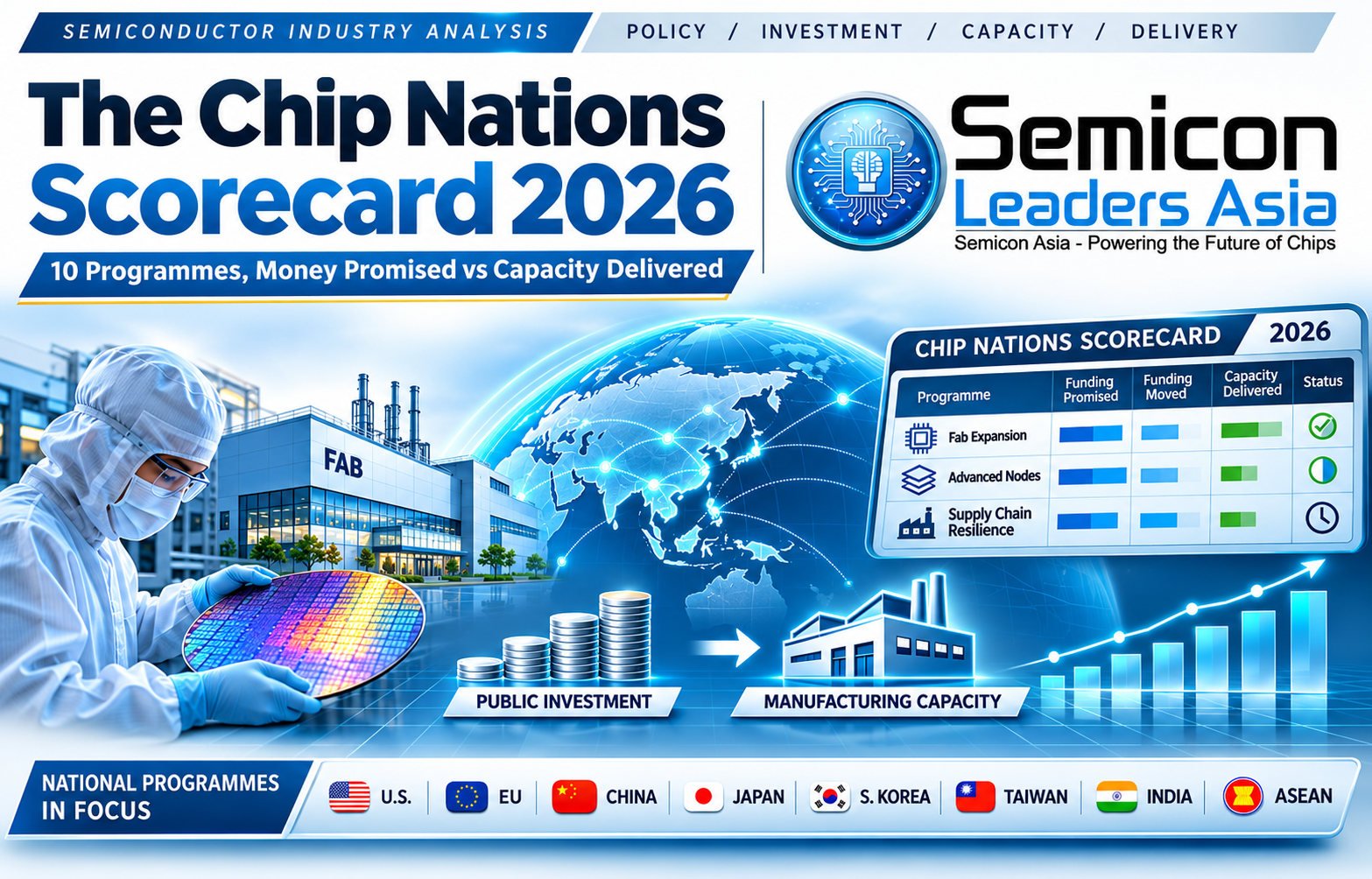
Governments have committed hundreds of billions to semiconductor sovereignty. Four years into the subsidy cycle, the sharper question is how much money has actually moved, which projects are producing, and where public reporting stops before delivery can be measured.
|
Key findings
- Only one of ten programmes, the US CHIPS manufacturing incentives, publishes a current consolidated disbursement figure: US$13.1 billion paid against about US$31.2 billion awarded.
- Delivery is now measurable. TSMC Arizona and JASM Kumamoto are producing, India has five of twelve approved plants in commercial production, and VSMC Singapore is in risk production.
- Schedules are moving. ESMC Dresden and JASM Fab 2 have each slipped a year, to 2028.
- China's RMB344 billion Big Fund III is the largest information gap: the capital is clear, the path from capital to capacity is not.
- A second subsidy cycle (Chips Act 2.0, Semicon 2.0) is starting before the first has fully matured, which makes disclosure a test of credibility.
|
Semiconductor industrial policy has become easy to announce and surprisingly hard to compare.
The United States talks in CHIPS Act awards. Europe blends EU funding, national state aid and private investment. Japan uses subsidies, commissioned research, equity and guarantees. Korea pairs public finance with far larger private investment plans. Taiwan leans on tax incentives, R&D infrastructure and private manufacturing. China uses national funds, tax policy and state-linked finance. India publishes programme outlays and project approvals. Singapore, Malaysia and Vietnam each run yet another model.
Line those numbers up without asking what they represent, and the comparison is close to meaningless.
A headline support package is not a disbursement. An approved project is not an operating fab. A groundbreaking is not wafer output. Private investment encouraged by policy is not government expenditure.
So Semicon Leaders Asia asks a narrower set of questions: what was publicly committed, what has demonstrably been paid, what capacity or infrastructure is operating, and which projects have moved off their original schedule.
The answer is less tidy than a conventional country ranking. That is precisely the point.
How the scorecard works
We track four measures, each drawn from published sources.
- Committed public support: a statutory budget, government support pool, state investment fund or other public commitment. Private corporate capex is shown separately and never counted as public money.
- Disbursed: money an official source says has actually been paid, invested or deployed. Awards, authorisations and investment targets do not count.
- Capacity delivered: commercial semiconductor production, or programme-funded infrastructure, that is already operating. Pilot lines are identified separately from commercial fabs.
- Delayed: the latest public schedule has moved beyond an earlier stated production date.
Where no consolidated programme-level figure exists, we say so rather than estimate one. And because these programmes are built so differently, we do not collapse them into a single grade. For suppliers and investors, the underlying measures are far more useful than an artificial overall score.
The 2026 chip nations comparison
|
Market
|
Headline public commitment
|
Disbursement evidence, 2026
|
Capacity or delivery visible
|
Delivery gap to watch
|
|
United States
|
US$39bn manufacturing incentives under CHIPS
|
US$13.1bn paid against about US$31.2bn in direct awards (Apr 2026), roughly 42%
|
TSMC Arizona Fab 1 in HVM; 49 projects across 24 companies (Jul 2026)
|
9 milestones past anticipated dates, none past contractual due dates
|
|
European Union
|
More than €3bn Chips for Europe, plus national state aid
|
No consolidated 2026 EU plus member-state cash figure
|
Five pilot lines operational; 19 first-of-a-kind state-aid decisions
|
ESMC Dresden slipped from 2027 to 2028
|
|
Japan
|
More than ¥10tn AI and semiconductor support through FY2030
|
Project-level: ¥250bn government equity into Rapidus in 2026
|
JASM Fab 1 producing; Rapidus pilot line operating
|
JASM Fab 2 slipped from 2027 to 2028
|
|
South Korea
|
KRW26tn support framework, then 2026 facilitation plans
|
No consolidated programme drawdown identified
|
HBM4 in commercial shipment; SK hynix M15X ramp
|
Public support and private capex reported together
|
|
Taiwan
|
NT$300bn Chip-based Industrial Innovation Program to 2033
|
No consolidated disbursement series identified
|
R&D pilot line under construction; TSMC N2 in HVM
|
Capacity is mostly private, so attribution is hard
|
|
China
|
RMB344bn registered capital, Big Fund III
|
No consolidated 2026 deployment figure
|
IC manufacturing investment up 11.5% (Jan to Jul 2026)
|
Fund-to-project attribution not public
|
|
India
|
₹76,000 crore Semicon 1.0 plus ₹1,27,500 crore Semicon 2.0
|
No consolidated cash-disbursement figure
|
12 projects approved; 5 in commercial production
|
Front-end fab still under construction
|
|
Singapore
|
S$800m RIE2030 semiconductor R&D flagship, plus NSTIC
|
No consolidated programme disbursement series
|
National R&D centres operating; VSMC in risk production
|
Public money is R&D-led; capacity is private
|
|
Malaysia
|
At least RM25bn fiscal support under the NSS
|
No NSS drawdown figure; RM1.4bn separate GLIC deployment (2025)
|
Mature base; front-end and packaging investment progressing
|
No single NSS ledger
|
|
Vietnam
|
Physical targets; no single semiconductor budget
|
No semiconductor-only disbursement figure
|
Packaging and test base; Viettel fab broke ground Jan 2026
|
Fab target ahead of delivered capacity
|
Note: Headline amounts are not directly comparable. Some are government budgets, some are fund capital, some combine multi-year instruments. Private corporate investment is excluded from the public-commitment column unless identified as part of a mobilised investment figure.
Chart 1. The biggest comparison problem is disclosure, not ambition
Only the United States publishes a current consolidated manufacturing-incentive disbursement figure. The EU, Japan and Malaysia offer useful project-level or adjacent deployment data, but nothing that matches a programme-wide semiconductor cash total. For Korea, Taiwan, China, India, Singapore and Vietnam, official sources provide commitments, approvals or project milestones, without a consolidated current disbursement figure that maps to the headline programme.
That information gap is itself one of the central findings of this year's scorecard. With that in mind, here is how each programme stands.
1. United States: the money is moving, but not every milestone is on schedule
What happened
The US CHIPS manufacturing programme remains one of the few where committed awards and actual payments can be separated with real precision.
In its August 2026 report (GAO-26-109121), the Government Accountability Office found that Commerce had funded 49 projects across 24 companies by 15 July 2026, nine more than a year earlier. As of April, about US$31.2 billion in direct funding had been awarded and US$13.1 billion disbursed, roughly 42% of the total. Of the 144 milestones across those projects, 24 had been completed and paid.
There is real output behind the money. TSMC's first Arizona fab has been in high-volume N4 production since the fourth quarter of 2024. Its second fab is in tool move-in, with N3 production scheduled for Q3 2027.
Why it matters
The US case shows the difference between an award and a reimbursement. CHIPS payments are milestone-based: companies spend first, demonstrate delivery, then receive funding. That makes disbursement a useful proxy for project progress.
It also surfaces delay early. GAO found nine milestones past their anticipated dates as of April 2026, although every contractual due date had still been met.
Research is a different story. GAO said Commerce cancelled awards representing US$7.8 billion of the US$11 billion appropriated for advanced microelectronics R&D as the programme was reworked. That leaves manufacturing awards untouched, but it means the CHIPS programme entering 2027 looks materially different from the one Congress designed. GAO also expects most manufacturing projects to complete by 2028, with all finishing by 2033.
What to watch in 2027
Announced investment is no longer the number that matters. The test is the pace at which the remaining awards convert into milestone payments and qualified production. TSMC Arizona Fab 2 and Micron's new US memory capacity will be the clearest signals.
2. European Union: strong project mobilisation, weaker cash visibility
What happened
The European Chips Act has built a large pipeline, but turning that pipeline into one public-money figure is harder.
The Commission says the Act has helped mobilise more than €80 billion in announced or planned investment. The Chips for Europe Initiative carries more than €3 billion in EU funding, matched by participating states, and 85% of its budget is committed. Five pilot lines are operational, representing €3.7 billion of investment, and the Commission has approved 19 state-aid decisions for first-of-a-kind facilities worth more than €33 billion in public and private investment.
One visible 2026 delivery was NanoIC at imec in Leuven. The €2.5 billion pilot line opened in February, with €700 million from the EU and €700 million from national and regional governments.
Why it matters
Europe has delivered research infrastructure faster than commercial fabs.
The latest state-aid expenditure scoreboard still reports actual semiconductor aid only through 2024. So the Commission can show approved investment and operating pilot lines, but not a single 2026 figure for how much national semiconductor aid has actually been paid.
There is a visible schedule change too. ESMC's Dresden fab was initially targeted for 2027 production; NXP now says initial production is targeted for 2028.
What to watch in 2027
Chips Act 2.0 is already proposed. The more immediate test is whether first-of-a-kind approvals turn into commercial capacity at the same pace as Europe's pilot infrastructure.
3. Japan: direct state capital has joined the subsidy model
What happened
Japan's semiconductor policy has moved well beyond grants.
METI's AI and Semiconductor Industrial Infrastructure Strengthening Framework commits more than ¥10 trillion in public support through FY2030, intended to draw more than ¥50 trillion of public and private investment over ten years.
Rapidus is the clearest example. By the end of FY2025, approved commissioned research support had an upper limit of about ¥1.7225 trillion. In 2026, the government added equity: ¥100 billion in February and ¥150 billion in June, through the Information-technology Promotion Agency.
Production has followed. TSMC's first JASM fab in Kumamoto entered volume production at the end of 2024. Rapidus is running a pilot line and still targets 2nm mass production in 2027.
Why it matters
Japan offers one of the clearest links between policy money and specific manufacturing projects.
It also shows why capacity has to be tracked separately from money. JASM Fab 2 was originally scheduled for the end of 2027; TSMC now plans 3nm production there in 2028. The move may yield a more advanced fab, but suppliers who planned around the 2027 date still face a one-year delay.
What to watch in 2027
Rapidus must move from pilot silicon and government capital to customer wafers. Its 2nm start will be one of the cleanest tests anywhere of whether industrial policy can compress the time it takes to build a leading-edge foundry.
4. South Korea: enormous capacity plans, harder-to-isolate public money
What happened
Korea presents a different reporting problem.
The government's earlier support framework totalled KRW26 trillion, combining low-cost finance, fiscal support and infrastructure. In 2026, policy shifted toward accelerating much larger private investment.
The June strategy calls for memory capacity to double within five years, a KRW800 trillion production cluster in the south-west and major packaging investment in Chungcheong. Those figures are largely corporate investment, not government spending, and should not be read as a subsidy programme.
Capacity is moving regardless. Samsung began commercial HBM4 shipments in February. In October, SK hynix said it was ramping M15X to maximum capacity and that Yongin Phase 1 would enter full-scale operation in 2027.
Why it matters
Korea's model relies on national champions committing their own capital while the state supplies finance, infrastructure, tax and permitting support. It can deliver very large capacity without a US-style grant ledger.
It also makes comparison difficult. A KRW800 trillion private investment plan does not belong in the same column as a US$39 billion federal incentive programme.
What to watch in 2027
Watch the government's actual financing and infrastructure execution around Yongin, Chungcheong and the newly proposed regional clusters. The capacity story is strong; the public-money story needs more granular disclosure.
5. Taiwan: public money backs the technology base, not the fab balance sheet
What happened
Taiwan's model is structurally different again.
The government plans to invest NT$300 billion through 2033 under the Chip-based Industrial Innovation Program, focused on advanced research infrastructure, next-generation chip design, EDA, silicon photonics, quantum technology, process verification and talent.
In February, the Ministry of Economic Affairs broke ground on Taiwan's first 12-inch advanced semiconductor R&D pilot line at ITRI, due for completion in December 2027.
Commercial manufacturing, meanwhile, remains overwhelmingly a corporate story. TSMC says N2 entered high-volume manufacturing in Q4 2025, expects N2-family capacity to more than double in 2027, and is building 13 leading-edge and advanced-packaging fabs in Taiwan over the next several years.
Why it matters
Taiwan is a warning against judging industrial policy by subsidy size alone. The state already has the cluster it wants to protect, so its money targets R&D infrastructure, design tools, talent, equipment localisation and tax incentives rather than a large share of any new fab.
A simple money-promised-versus-fabs-delivered calculation therefore understates what Taiwan's policy is doing.
What to watch in 2027
The advanced R&D pilot line and domestic equipment programmes will show whether Taiwan can shore up weak points around its world-leading manufacturing base, rather than simply adding wafer capacity.
6. China: the largest information gap in the comparison
What happened
China's third National Integrated Circuit Industry Investment Fund, Big Fund III, was established with registered capital of RMB344 billion.
Official banking approvals show substantial state-linked contributions, including RMB36 billion routed through China Development Bank's investment arm and large commitments from the major state banks.
By September 2026, the National Development and Reform Commission said Big Fund III had fully begun deploying capital, and reported that integrated-circuit manufacturing investment rose 11.5% year on year in the first seven months of 2026.
Why it matters
The size of the fund is not the problem. Tracing money from fund capital to specific capacity is.
Official sources provide no consolidated Big Fund III disbursement ledger comparable with the US CHIPS figure, and no complete project list linking each investment to capacity already producing. RMB344 billion is a capital commitment, not evidence that RMB344 billion has reached fabs.
China also supports the sector through tax policy: qualifying manufacturing projects below 28nm can receive up to ten years of corporate income-tax exemption.
What to watch in 2027
Watch whether more Big Fund III investments become individually attributable to equipment, materials, memory and manufacturing projects. Until then, the scale is clear but the conversion from capital to capacity remains hard to audit from outside.
7. India: from two producing plants to five in seven months
What happened
India shows exactly why a scorecard needs a date stamp.
On 1 April 2026, PIB said two Semicon India plants, Micron and Kaynes, had started commercial production.
On 15 July, when Cabinet approved Semicon 2.0 with a ₹1,27,500 crore outlay, the count had reached three: Micron, Kaynes and CG Semi. Twelve manufacturing projects had been approved, with cumulative investment above ₹1.64 lakh crore. Of those, one is a silicon fab, two are compound semiconductor fabs and nine are assembly, test and packaging units.
In September, two more units opened commercial lines, and by October the government said five of the twelve approved projects were in commercial production. Officials reiterated that figure in early November, as Semicon 2.0 opened for applications.
Semicon 1.0 itself carried an outlay of ₹76,000 crore, which officials have described as largely committed across approved projects.
Why it matters
This resolves the apparent contradiction in Indian government material over the year. It was never two versus three; the count rose as plants came online. The current official figure is five.
What remains harder to find is a consolidated figure for how much of the ₹76,000 crore has actually been paid to beneficiaries. India publishes project progress more clearly than programme cash execution.
What to watch in 2027
The biggest shift will come when India moves from packaging-led output to front-end wafer production. Tata's Dholera fab remains the project most likely to change India's position in the manufacturing chain.
8. Singapore: a modest public programme, very large private follow-through
What happened
Singapore is another case where the public headline badly understates the manufacturing response.
Under RIE2030, the government has committed S$800 million to a semiconductor R&D flagship spanning areas including advanced packaging and photonics. It has also set up national semiconductor translation centres, including a power-electronics centre backed by S$60 million and an R&D fab supported under earlier NSTIC plans.
The commercial investment around that base is far larger. EDB says Singapore attracted more than S$30 billion in semiconductor investment from 2022 to 2025. In 2026, Micron broke ground on a US$24 billion wafer fab and Applied Materials opened a US$500 million manufacturing campus.
The standout delivery is VSMC, the VIS and NXP joint venture. Its first 300mm fab in Tampines opened on 28 September after 22 months of construction and has entered risk production. Its first sample lot yielded above 99%, volume production is scheduled for Q1 2027, and capacity is planned to reach about 44,000 wafers a month by 2029.
Why it matters
Singapore shows why government spending and delivered private capacity must be displayed separately. The state funds research capability, talent and infrastructure; multinationals supply most of the fab capital. There is no public grant ledger resembling CHIPS, and none is really needed to see the result.
What to watch in 2027
VSMC's volume ramp and the opening of the national R&D fab will test whether Singapore can keep moving from manufacturing location to technology-development centre.
9. Malaysia: RM25 billion promised, but cash execution is not yet one public number
What happened
Malaysia's National Semiconductor Strategy (NSS) commits at least RM25 billion in fiscal support.
The framework includes RM10 billion in capital grants over 2023 to 2038, RM1 billion for a high-impact fund for multinationals, RM1 billion for a domestic strategic investment fund, and further talent and R&D support.
There is some evidence of public-linked capital reaching the sector. The Finance Ministry said government-linked investment companies deployed RM1.4 billion into higher-value semiconductors in 2025 under the separate GEAR-uP initiative. That is not an NSS drawdown, but it is evidence of deployment.
Private delivery continues. NXP broke ground in August on a new assembly and test facility in Petaling Jaya expected to more than double site output once fully operational.
Why it matters
With a mature base already in place, Malaysia's aim is not another packaging plant. The NSS is pushing into IC design, front-end equipment, advanced packaging and higher-value local ownership, and MIDA says 2026 investment is already tilting toward front-end design and equipment.
What is missing is a single NSS table linking commitment, approval, payment and capacity to each fiscal-support line.
What to watch in 2027
The most useful measure will be how much of the RM25 billion is tied to named projects, and how much local value those projects create beyond assembly and test.
10. Vietnam: a capacity target before a subsidy number
What happened
Vietnam is the outlier: it sets physical industry targets without attaching them to a single semiconductor fund.
By 2030, the government wants at least 100 design companies, one small-scale fabrication plant and 10 packaging and testing plants, alongside a semiconductor workforce of more than 50,000 engineers and graduates.
An Investment Support Fund can back high-tech projects, including semiconductor R&D, but its remit is broader than chips and the strategy states no semiconductor-only commitment.
The capacity story moved in January 2026, when Viettel broke ground on what the government describes as Vietnam's first semiconductor chip fabrication plant. Official reporting says the country already has nearly 60 chip-design companies, 13 of them domestic, almost 6,000 semiconductor engineers and a substantial packaging and test position.
Why it matters
Vietnam shows that industrial policy does not have to start with a subsidy pool. Its first phase prioritises workforce, design, FDI, packaging and test, with domestic fabrication added on top. That makes its capacity targets easier to read than any funding comparison.
What to watch in 2027
Viettel's fab construction is the main test. The next question is whether Vietnam can turn its packaging and multinational base into a deeper local supplier and design ecosystem.
What the scorecard actually shows
The most striking result is not which government announced the biggest number. It is how differently public money is being used.
The United States runs the closest thing to a milestone-based grant model, with enough reporting to separate awards from cash paid. Europe has mobilised a large pipeline, but its public record is stronger on commitments, state-aid approvals and pilot lines than on 2026 payments. Japan combines grants, commissioned research and direct government equity.
Korea and Taiwan lean on private national champions, backed by infrastructure, tax, research and finance rather than one dominant subsidy ledger. China has a very large national fund, but fund-to-project deployment is not published in a form that supports a US-style ratio.
India publishes unusually clear project counts, and its latest figure of five producing units is far more useful than the two or three repeated earlier in the year. Singapore's public R&D budget is small next to the private fabs it anchors. Malaysia has a large published framework but no clean disbursement view. Vietnam still defines success through capacity and workforce targets.
The Semicon Leaders Asia view
Three lessons matter as the industry heads into 2027.
1. Stop comparing headline packages as if they were the same thing
A registered investment fund, a federal grant appropriation, a tax credit, a government equity stake and a private corporate commitment are five different financial instruments. Ranking them in one league table makes a compelling graphic and weak analysis. For suppliers, the only question that matters is whether the money turns into purchase orders.
2. Capacity delivery is separating programmes from announcements
TSMC Arizona is producing. JASM Fab 1 is producing. Five Indian projects are commercially operating. VSMC Singapore is in risk production. European pilot lines are open. Samsung and SK hynix are shipping next-generation HBM.
At the same time, ESMC Dresden and JASM Fab 2 show why every announced schedule needs continual checking. The subsidy cycle has reached the point where execution can finally be measured.
3. Disclosure will become part of industrial-policy credibility
As programmes mature, governments face a harder question than how much they committed. How much was paid? Which milestone triggered the payment? What capacity came online? What slipped, and what changed after approval?
The United States already publishes enough to start that conversation. India increasingly publishes project delivery, if not cash. Elsewhere, the record is fragmented, and that matters because a second subsidy cycle is starting before the first has matured. The EU has proposed Chips Act 2.0, India has launched Semicon 2.0, Japan's framework runs to 2030, Korea has announced a new generation of clusters, and Taiwan is building its next technology base.
The next round deserves a harder standard.
Money promised is policy. Money paid against completed milestones is execution. Capacity producing qualified chips is the result.
In 2027, the strongest semiconductor programmes will not be the ones with the largest headlines. They will be the ones that make the distance between those three numbers visible.
Sources: US Government Accountability Office (GAO-26-109121, August 2026); European Commission; METI and IPA; Government of the Republic of Korea; Taiwan Ministry of Economic Affairs; NDRC; PIB, MeitY and India Semiconductor Mission; Singapore EDB and VSMC; Malaysia Ministry of Finance and MIDA; Government of Vietnam; company disclosures. All figures as of 12 November 2026.