12 Fabs Due to Start Production in 2027, and How Close Each Really Is
12 November 2026 |
Feature
From Arizona and Boise to Chitose, Dholera and Singapore, billions of dollars of new semiconductor capacity is meant to arrive in 2027. But a finished building, a ready cleanroom and qualified wafer output are three very different milestones
For semiconductor equipment and materials suppliers, 2027 is shaping up as a big capacity year.
TSMC expects new 3nm capacity in both Taiwan and Arizona. Micron is preparing its first new US memory fab for wafer output. SK hynix is opening the first production phase of its Yongin cluster. Rapidus still targets 2nm mass production in Japan. India expects its first commercial front-end fab to begin production, and Singapore is about to ramp a new 300mm foundry that has already processed sample wafers.
The catch is that "start" means something different at almost every project.
A completed shell is not a production fab. Tool move-in is not qualified capacity. Risk production is not customer volume. Even a cleanroom opening can come months before any useful wafer output.
That gap matters to anyone selling lithography, deposition, etch, metrology, chemicals, gases or fab infrastructure. Their territory plans depend less on the ribbon-cutting date than on when tools arrive, when qualification begins and when recurring process-material consumption kicks in.
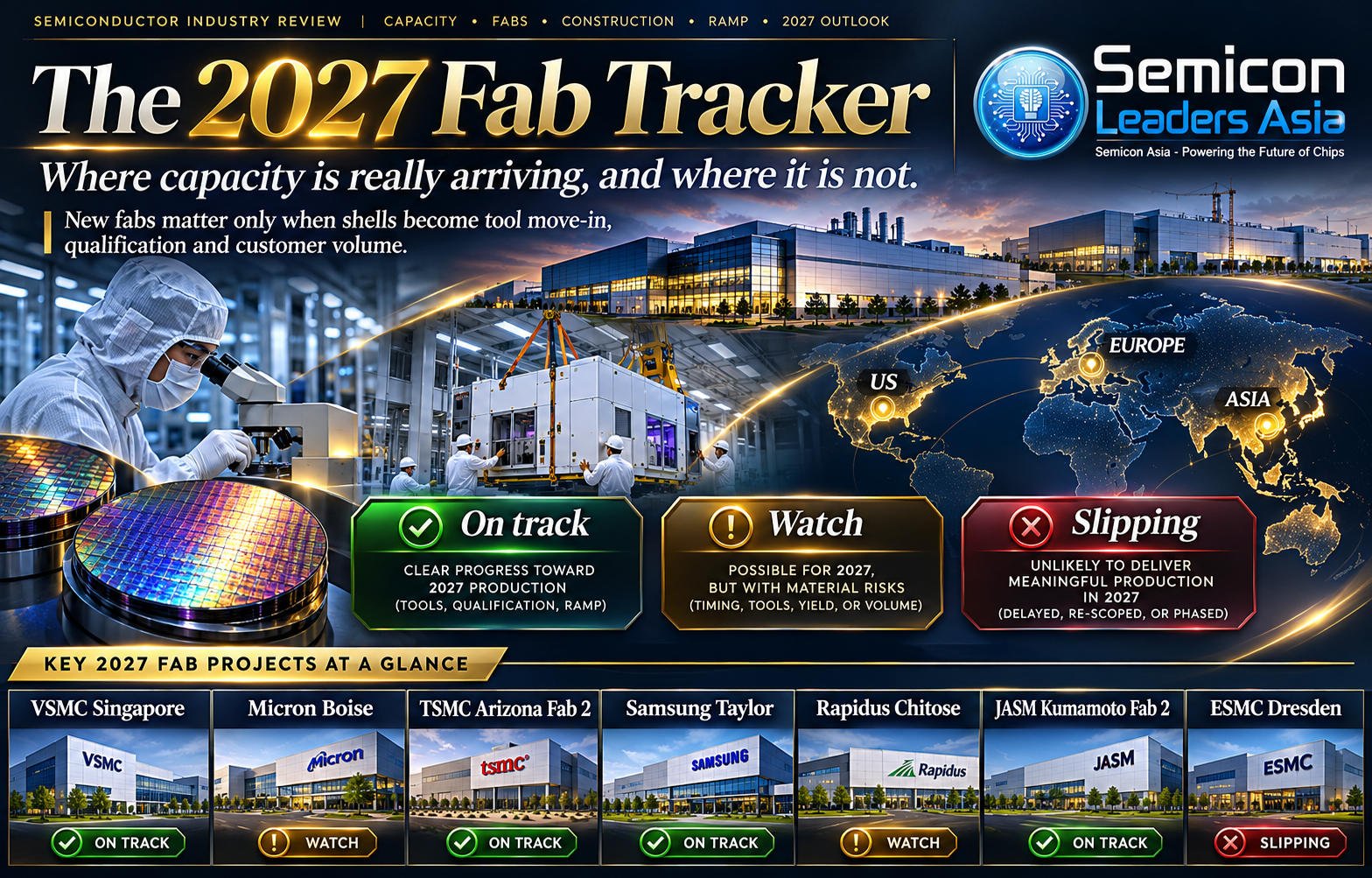
So Semicon Leaders Asia reviewed 12 fabs publicly associated with a 2027 production start and rated each against the latest available evidence.
At a glance
- 6 on track: VSMC Singapore, Micron Boise, TSMC Tainan, TSMC Arizona Fab 2, SK hynix Yongin Y1 and Infineon Kulim.
- 4 on watch: Samsung Taylor, Rapidus Chitose, Tata Dholera and Texas Instruments Sherman SM2.
- 2 slipping to 2028: JASM Kumamoto Fab 2 and ESMC Dresden.
- Asia hosts seven of the twelve projects, from leading-edge logic and memory to specialty, power and India's first commercial front-end fab.
How we rated them
On track: The company still publicly supports a 2027 production date, backed by tangible evidence such as completed construction, tool installation, risk production or an accelerated cleanroom schedule.
Watch: The 2027 target remains plausible, but important dependencies are unresolved, such as tool installation, customer commitments, yield qualification or demand-dependent capacity decisions.
Slipping: A project originally targeted for 2027 now has a public production schedule extending into 2028.
The 2027 fab tracker
|
Company
|
Site
|
Node or type
|
Stated start
|
Latest evidence
|
Rating
|
|
VSMC (VIS and NXP)
|
Singapore
|
130nm to 40nm analogue, power, mixed-signal
|
Q1 2027
|
Construction complete, risk production under way, first sample lot above 99% yield
|
On track
|
|
Micron
|
Boise, Idaho
|
Leading-edge DRAM
|
Mid-2027
|
Construction progressing; company reconfirmed first wafer output timing
|
On track
|
|
TSMC
|
Tainan, Taiwan
|
3nm
|
H1 2027
|
TSMC says volume production is "well on track"
|
On track
|
|
TSMC
|
Arizona Fab 2
|
3nm
|
Q3 2027
|
Building complete; tool move-in and installation under way
|
On track
|
|
Samsung Electronics
|
Taylor Fab 1, Texas
|
Advanced foundry, including 2nm
|
2027
|
Now says operations commence in 2027, after earlier 2026 readiness language
|
Watch
|
|
SK hynix
|
Yongin Y1, Korea
|
Advanced memory
|
2027
|
First cleanroom brought forward to February 2027
|
On track
|
|
Rapidus
|
IIM-1, Chitose
|
2nm GAA
|
H2 FY2027
|
Pilot line operating, state funding continuing, customer talks active
|
Watch
|
|
Tata Electronics
|
Dholera, Gujarat
|
28nm to 110nm
|
2027
|
Government still states 2027; supplier and infrastructure agreements expanding
|
Watch
|
|
Infineon
|
Kulim Module 3 Phase 2, Malaysia
|
200mm SiC
|
Summer 2027
|
Official roadmap maintains date; 200mm substrate supply expanding
|
On track
|
|
Texas Instruments
|
Sherman SM2, Texas
|
28nm to 130nm analogue and embedded
|
Ramp from 2027
|
Shell complete, but tool installation remains demand-dependent
|
Watch
|
|
JASM (TSMC)
|
Kumamoto Fab 2, Japan
|
3nm
|
Originally end-2027
|
Latest TSMC guidance says 2028
|
Slipping
|
|
ESMC (TSMC, Bosch, Infineon, NXP)
|
Dresden, Germany
|
28/22nm and 16/12nm
|
Originally end-2027
|
NXP now targets initial production in 2028
|
Slipping
|
1. VSMC Singapore: the clearest 2027 start on the list
Rating: On track
What happened
VisionPower Semiconductor Manufacturing Company (VSMC), the joint venture between Vanguard International Semiconductor and NXP, opened its new 300mm fab in Tampines on 28 September.
Construction is complete. More tellingly, the fab is already in risk production and has processed its first sample lot with reported yields above 99%. Volume production remains scheduled for Q1 2027.
The fab will make 130nm to 40nm mixed-signal, power-management, analogue and interposer products, with capacity expected to reach around 44,000 300mm wafers per month by 2029.
Why it matters
This is what an on-track fab looks like a few months before meaningful production: the building is finished, process tools are running and wafers are already moving through the line.
It also gives Singapore another front-end anchor alongside its established packaging and specialty manufacturing base.
What to watch in 2027
The next milestone is the move from sample lots to qualified customer products. Equipment suppliers should shift attention from installation to spares, process materials and production support.
2. Micron Boise Fab 1: US DRAM returns in 2027
Rating: On track
What happened
Micron continues to target mid-calendar 2027 for first wafer output from its new fab in Boise, Idaho.
The company reconfirmed that timing in July while updating on its wider US manufacturing programme. Boise will produce leading-edge DRAM next to Micron's R&D operation, with HBM among the products set to benefit from the expanded US memory base.
Why it matters
Boise is one of the few 2027 projects adding leading-edge memory wafer capacity rather than logic or mature-node output.
That makes its ramp relevant far beyond the US. More DRAM cleanroom space ultimately shapes how the industry can split wafers between conventional DRAM and HBM.
What to watch in 2027
First wafer output is not the same as meaningful bit supply. Watch yield, technology qualification and how quickly the fab moves from initial wafers to high-volume output.
3. TSMC Tainan: another 3nm fab arrives in the first half
Rating: On track
What happened
TSMC is adding a new 3nm fab to its Tainan Science Park cluster.
On its 15 October third-quarter earnings call, the company said volume production remained well on track for the first half of 2027. It has also committed to a further Tainan 3nm fab for the first half of 2028, as AI and high-performance computing demand keeps absorbing leading-edge capacity.
Why it matters
It is one of the least geopolitically dramatic fabs on this list, and potentially one of the most important commercially.
Unlike an overseas greenfield project, Tainan adds capacity inside an existing cluster of suppliers, skilled workers and infrastructure. That should make for a smoother ramp.
What to watch in 2027
Watch how much incremental N3 wafer output TSMC generates, not simply whether the fab technically enters production.
4. TSMC Arizona Fab 2: construction risk is largely behind it
Rating: On track
What happened
TSMC's second Arizona fab has moved past building construction.
As of the third quarter, construction was complete and the company was in tool move-in and installation. Volume production on 3nm is scheduled for Q3 2027, slightly ahead of TSMC's earlier second-half target.
Why it matters
Fab 2 is the project that turns TSMC Arizona from a single-fab site into a genuine manufacturing cluster.
For equipment and materials suppliers, the valuable phase has already begun. Tool installation, hook-up, facilities qualification and process integration all create demand before the first commercial wafer ships.
What to watch in 2027
The test is whether Arizona's N3 yield and customer qualification follow the trajectory that carried Fab 1 successfully into N4 volume production.
5. Samsung Taylor Fab 1: 2027 looks real, but the milestone keeps moving
Rating: Watch
What happened
Samsung's language on Taylor has shifted repeatedly.
Earlier in 2026, the company still described the Texas plant as becoming operational during the year. By its third-quarter results on 29 October, Samsung said its foundry business expects to strengthen global supply capabilities in 2027 with the commencement of operations at its new fab in Taylor. It gave no more precise date.
Local reporting earlier this year pointed to pilot activity and substantial hiring, but also noted uncertainty about where operational readiness ends and meaningful mass production begins.
Why it matters
Taylor has major potential customers waiting for advanced US foundry capacity, and Samsung reports continued 2nm order wins from HPC customers, including major hyperscalers. But the project's history shows why construction headlines must be kept separate from customer production.
What to watch in 2027
Look for named customer production, wafer volumes and 2nm qualification, not another operational-opening announcement.
6. SK hynix Yongin Y1: the cleanroom schedule has accelerated
Rating: On track
What happened
SK hynix is accelerating the first phase of its vast Yongin semiconductor cluster.
In February, the company said the first cleanroom opening had been brought forward from May to February 2027, after approving a further KRW 21.6 trillion of investment in the first fab. Its October third-quarter update said Yongin Phase 1 would enter full-scale operation next year.
Why it matters
Yongin is not an incremental cleanroom addition. It is designed to become one of SK hynix's long-term production bases for advanced memory through the AI build-out.
The acceleration also hands materials and equipment suppliers an earlier installation window.
What to watch in 2027
The cleanroom opening is only the first milestone. Watch which memory processes move in first and how fast installed tools translate into bit output.
7. Rapidus IIM-1: technically close, commercially still unproven
Rating: Watch
What happened
Rapidus continues to target the second half of fiscal 2027 for 2nm GAA mass production at IIM-1 in Chitose, Hokkaido.
The pilot line has run since 2025. METI's 2026 review says Rapidus is investing to plan, is in discussions with more than 60 companies, and has reached rough-quotation stage with around ten. In October, Rapidus also launched its CORE ecosystem with 17 design partners.
Why it matters
Few 2027 fabs face a wider gap between technical success and commercial success.
Rapidus has to raise yield, complete its manufacturing system, qualify designs and convert conversations into paying production customers, all at the same time.
What to watch in 2027
A named anchor production customer would matter more than another technology demonstration. Hard yield and defect-density data would matter more still.
8. Tata Electronics Dholera: India still says 2027, but the public evidence is earlier-stage
Rating: Watch
What happened
India's government continues to state that Tata Electronics' Dholera fab will begin production in 2027.
Built with technology partner PSMC, the facility is designed for 50,000 300mm wafer starts per month across 28nm to 110nm. During 2026, Tata added an ASML agreement, semiconductor-materials supply partnerships and a collaboration with Kelington aimed at accelerating operational readiness.
Why it matters
Dholera would be India's first large-scale commercial front-end fab. For equipment and materials suppliers, its significance is far greater than its initial process nodes suggest.
But the public evidence is not yet as advanced as Singapore or Arizona. Tata has not disclosed an equivalent first-wafer or tool-installation milestone.
What to watch in 2027
Tool move-in, cleanroom qualification and the first publicly named production customer will decide whether the 2027 target becomes real wafer output.
9. Infineon Kulim Phase 2: SiC capacity still points to summer 2027
Rating: On track
What happened
The second expansion phase of Infineon's Module 3 in Kulim, Malaysia, remains scheduled to be production-ready in summer 2027.
It is part of Infineon's plan to build the world's largest 200mm silicon-carbide manufacturing base. The company's 2026 capacity roadmap kept the summer 2027 date, and an October supply agreement with Wolfspeed widened its access to 200mm SiC substrates for the transition.
Why it matters
This is a power-semiconductor fab rather than a logic fab, but AI data-centre power has now joined automotive and renewable energy as a major demand driver for SiC.
It is also a reminder that fab readiness depends on substrate availability as much as on tools.
What to watch in 2027
Watch utilisation rather than building completion. Infineon's modular investment model lets capacity ramp in line with customer demand.
10. Texas Instruments Sherman SM2: the building is ready, the demand signal is not
Rating: Watch
What happened
TI has completed the shell of SM2, its second 300mm fab in Sherman, Texas.
Its February capital-management materials show SM2 capacity coming on from 2027, but management has been explicit that equipment installation will follow demand. The fab will support TI's 28nm to 130nm analogue and embedded-processing portfolio.
Why it matters
SM2 illustrates a different kind of schedule risk.
There is little construction risk left. The question is whether TI needs the capacity soon enough to equip the shell aggressively.
For tool vendors, an empty cleanroom is not the same opportunity as a committed production ramp.
What to watch in 2027
Industrial and automotive demand will set the equipment schedule. Purchase orders will tell you more than construction milestones.
11. JASM Kumamoto Fab 2: a 2027 project that has moved to 2028
Rating: Slipping
What happened
When TSMC, Sony, Denso and Toyota announced JASM's second Kumamoto fab in February 2024, production was due to begin by the end of 2027.
That is no longer the plan.
TSMC's latest third-quarter guidance says JASM Fab 2 will use 3nm technology and start volume production in 2028. Construction began in 2025.
Why it matters
This is not necessarily a setback for the project. Moving to 3nm raises the fab's strategic value, but it also changes the tooling, qualification and customer requirements.
For suppliers who planned around the original 2027 ramp, though, the commercial effect is still a delay.
What to watch in 2027
Tool move-in and customer allocation will show how much of the one-year shift reflects the technology upgrade rather than construction timing.
12. ESMC Dresden: Europe's flagship new foundry is now a 2028 story
Rating: Slipping
What happened
The original ESMC announcement targeted production in Dresden by the end of 2027.
The joint venture between TSMC, Bosch, Infineon and NXP, worth more than €10 billion, is designed for 28/22nm planar CMOS and 16/12nm FinFET, with planned capacity of around 40,000 300mm wafers per month.
NXP's latest reporting now says initial production is targeted for 2028.
Why it matters
Europe still gets strategically important automotive and industrial capacity, but suppliers expecting a 2027 ramp need to reset their schedules.
It is exactly why equipment territory planning should follow current company filings rather than the original subsidy announcement.
What to watch in 2027
Construction progress, tool installation and any updated ramp schedule from ESMC or its shareholders will determine how early in 2028 meaningful output can begin.
What the 2027 fab map really says
The headline number is twelve. The more useful number is six.
Six projects currently have enough public evidence to earn an On track rating: VSMC Singapore, Micron Boise, TSMC Tainan, TSMC Arizona Fab 2, SK hynix Yongin and Infineon Kulim.
Four deserve closer monitoring. Samsung Taylor is clearly nearing production, but its milestone language keeps moving. Rapidus has a working pilot line but still has to prove the economics and customers behind 2nm volume. Tata Dholera has strong policy and supplier momentum but fewer disclosed manufacturing milestones. TI's SM2 shell is ready, but its ramp depends explicitly on demand.
Two projects have already left the 2027 production window: JASM Fab 2 and ESMC Dresden.
For suppliers, that distinction is not academic, because each stage of a fab's life generates a very different kind of revenue.
|
Fab stage
|
What it means for suppliers
|
Where the 2027 list sits
|
|
Shell complete
|
Construction and facilities work; little recurring semiconductor-material demand yet
|
TI Sherman SM2
|
|
Tool move-in and installation
|
Peak equipment delivery, hook-up, facilities qualification and field-service demand
|
TSMC Arizona Fab 2; SK hynix Yongin Y1 from early 2027
|
|
Pilot or risk production
|
Process gases, chemicals, wafers, spares and replacement parts start flowing
|
VSMC Singapore; Rapidus IIM-1 (pilot)
|
|
Yield qualification
|
Metrology, inspection and process-control demand intensifies
|
Next step for VSMC, Rapidus and the TSMC 3nm fabs
|
|
Customer volume
|
Recurring, predictable consumables and service revenue
|
Targeted across most of the list during 2027
|
A fab in risk production starts consuming process gases, chemicals, wafers and replacement components. A shell waiting for demand generates construction work but not recurring material sales. And a fab whose production date moves by a year can shift hundreds of tool installations, and the supplier hiring decisions behind them, along with it.
Semicon Leaders Asia view
Three conclusions stand out.
1. 2027 capacity is spread across very different markets
The new output ranges from TSMC's 3nm logic and Micron's leading-edge DRAM to VSMC's 130nm to 40nm specialty processes and Infineon's silicon carbide.
There is no single "fab cycle". Equipment and materials suppliers need to follow the technology mix, not just the count of new buildings.
2. Asia still provides the deepest manufacturing ecosystem
Even as Arizona, Boise and Taylor expand US output, Asia supplies most of the supporting density.
Taiwan adds leading-edge logic. Korea adds memory. Japan is building both advanced logic and specialty capacity. Singapore and Malaysia expand specialty and power production, and India is attempting its first large commercial front-end ramp.
For suppliers, the map is diversifying without becoming any less Asian.
3. Treat production dates as a sequence, not a day
The strongest evidence is never a groundbreaking ceremony.
It is construction completion, then tool move-in, first wafer, risk production, yield qualification and, finally, customer volume.
VSMC has already reached risk production. Arizona Fab 2 is installing tools. Rapidus has a pilot line but still has to prove commercial volume. Dholera is building the supplier and infrastructure layer around the fab. Dresden and Kumamoto show that even the most strategic projects can move a year when technology or execution changes.
Which leads to the practical lesson for 2027 planning.
The fabs that matter most to equipment and materials sellers are not simply the ones scheduled to open. They are the ones closest to consuming production inputs every day.
Sources
- https://investors.nxp.com/news-releases/news-release-details/vsmc-celebrates-grand-opening-its-first-300mm-fab-singapore
- https://investor.tsmc.com/english/quarterly-results/2026/q3
- https://pr.tsmc.com/english/news/3105
- https://www.nxp.com/docs/en/supporting-information/NXP202510K.pdf
- https://news.samsung.com/global/samsung-electronics-announces-third-quarter-2026-results
- https://news.skhynix.com/en/fab-facility-investment-2026/
- https://news.skhynix.com/en/new-facility-investment-for-yongin-semiconductor-cluster/
- https://www.rapidus.inc/en/news_topics/news-info/20261005-2/
- https://www.rapidus.inc/en/iim/
- https://www.pib.gov.in/PressNoteDetails.aspx?ModuleId=3&NoteId=152130&lang=1®=3
- https://www.pib.gov.in/newsite/erelcontent.aspx?lang=2®=48&relid=279106
- https://www.infineon.com/press-release/2026/infpr202610-008
- https://www.infineon.com/assets/row/public/documents/corporate/investors/presentations/2023/2023-08-03-q3-fy23-investor-presentation.pdf
- https://investor.ti.com/node/37646
- https://investors.micron.com/overview/default.aspx
- https://investors.micron.com/news/press-release/2026/Micron-Advances-Made-in-America-Memory-With-Manufacturing-Expansion-in-Virginia/default.aspx