For most of the past three years, the semiconductor industry has measured AI progress in one direction. Models have grown larger, clusters have grown denser, and accelerators have been paired with more high-bandwidth memory with each generation. That build-out has been remarkable, and it will continue. As we look toward 2027, though, the constraints shaping our industry are becoming as important a...
For most of the past decade, the semiconductor industry has answered AI's appetite for compute by just building more of it. More cores, more accelerators, more transistors, more advanced process nodes. It worked, and it worked remarkably well. But heading into 2027, with the continuing growth in model size, the exploding usage, the data needed, that playbook is running out of road. The reason is ...
As advanced packaging and semiconductor manufacturing become increasingly complex, demand for efficient, sustainable wafer-cleaning technologies is growing. SUSS is entering this market with GreenTec Solutions, expanding its photomask cleaning expertise into wafer-level applications. Semicon Leaders Asia speaks with Yuta Nagai, Senior Vice President, Photomask Solutions at SUSS, about the company'...
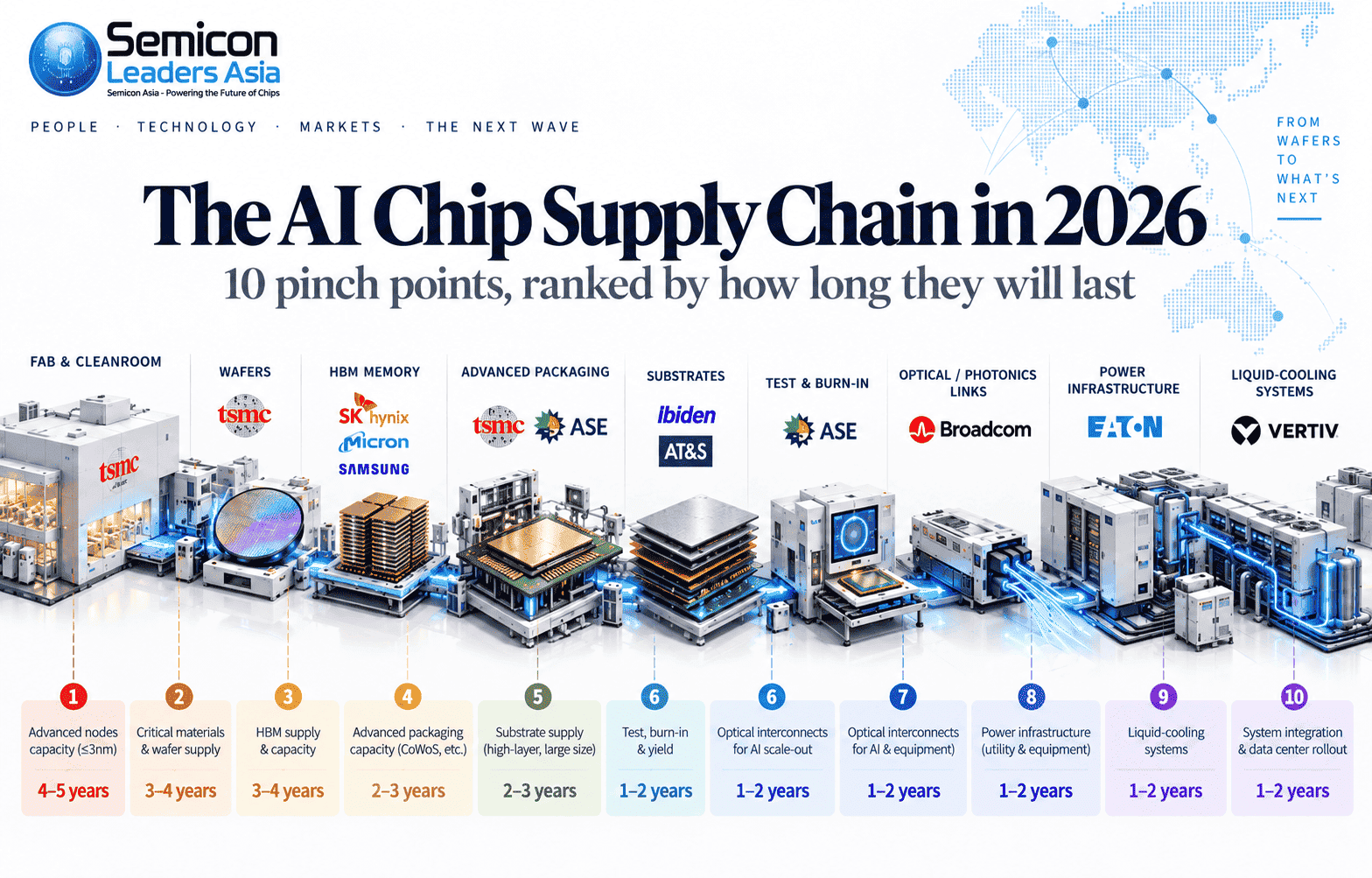
SEMICON LEADERS ASIA ANALYSIS | OCTOBER 2026 Key takeaways HBM is the most severe shortage of 2026, but not the most durable. Record memory capex should bring meaningful relief by 2028, even if supply does not fully normalise in 2027. Wafers, CoWoS-class packaging and liquid cooling are cyclical constraints. Committed capacity with visible start dates should ease them from the second half of ...
As demand for faster, more energy-efficient AI infrastructure grows, co-packaged optics (CPO) is creating new opportunities for Asia's semiconductor foundries, packaging providers and photonics manufacturers. However, scaling production requires advances in wafer bonding, materials integration and precision manufacturing. Semicon Leaders Asia speaks with Dr Bernd Dielacher, Director of Busine...

The Tamil Nadu government has introduced the Tamil Nadu Semiconductor Ecosystem Scheme 2026, offering capital subsidies of up to 25% to attract semiconductor manufacturing and supply chain investments. Chief Minister C. Joseph Vijay launched the scheme on 15 October 2026 at the State Secretariat in Chennai. The programme is designed to support semiconductor projects across fabrication, assembly, ...
As AI infrastructure drives demand for higher-bandwidth, power-efficient optical connectivity, the challenge for silicon photonics companies is shifting from technological innovation to commercial-scale production. OpenLight is looking to capitalise on this transition through its heterogeneous silicon photonics platform, integrated laser technology and roadmap extending from 1.6T to 3.2T optical c...
KEY TAKEAWAYS Governments spent 2026 managing flows rather than stopping them: licences with conditions, tariffs with carve-outs, minerals rules backed by enforcement. Industrial policy moved beyond the fab into packaging, materials, equipment, design and talent, from New Delhi to Brussels to Seoul. For buyers, available capacity and accessible capacity are no longer the same thing. Complianc...

Semiconductor headlines in 2026 have been unusually large. AI accelerator demand kept climbing. Memory prices surged. Washington rewrote parts of its China chip policy. Beijing's domestic AI hardware push gathered pace. India committed another ₹1,27,500 crore to semiconductors through Semicon 2.0, and Japan kept putting public and private capital behind Rapidus. The market numbers make the exci...
For most of the industry’s history, progress meant one thing: pack more functions onto a single piece of silicon. That playbook still works for plenty of products. But at the frontier, in AI accelerators, data-centre processors and high-end networking, it is running into hard limits of physics, yield and cost. The response is a quiet but fundamental change in how chips are conceived. Instead...
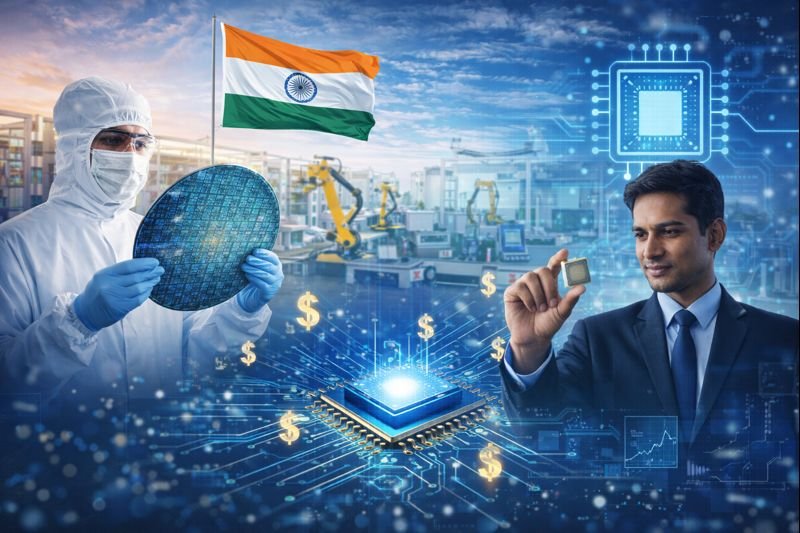
India’s Union Budget 2026 marks a clear inflection point in the country’s semiconductor ambition. What emerges is not a tactical incentive programme but a calibrated national strategy designed to reposition India from a peripheral electronics base to a credible node in the global semiconductor value chain. For global semiconductor and electronics multinationals,...
China is accelerating efforts to reduce dependence on imported high end artificial intelligence processors, with leading technology companies and research institutions reassessing the use of Nvidia’s H200 chips in favour of locally developed solutions. This transition reflects a wider national push to strengthen technological self reliance, particularly in critical areas...
Growth in 300 mm Shipments Fueled by AI to Support Advanced Logic, Cloud Computing and Memory Applications The SEMI Silicon Manufacturers Group (SMG) reported , in its quarterly analysis of the silicon wafer industry, that worldwide silicon wafer shipments increased 3.1% year-on-year to 3,313 million square inches (MSI) from the 3,214 MSI recorded during the same quarter of 2024. Sequent...
SolarEdge and Infineon are partnering to advance the development of highly efficient next-generation Solid-State Transformer (SST) technology for AI and hyperscale data centers The new SST is designed to enable direct medium-voltage to 800–1500V DC conversion with over 99% efficiency, reducing size, weight, and CO₂ footprint The collaboration combines SolarEdge’s DC expertise...
Taiwan’s Ministry of Economic Affairs has announced new export pre-approval measures for semiconductor products destined for South Africa, adding another layer of scrutiny to global chip supply chains. The move underscores how geopolitical and security considerations are increasingly shaping the flow of critical technologies — even to markets not tradition...
Taiwan’s representative to the Asia-Pacific Economic Cooperation (APEC) summit held a high-level meeting with US Treasury Under-Secretary for International Affairs, Jay Bessent, to discuss joint approaches to semiconductor policy, trade resilience, and innovation partnerships. The closed-door meeting, lasting approximately 40 minutes, focused on advancing cooperation across the semiconduc...
Sweden and Malaysia have formalised a landmark memorandum of understanding (MoU) to advance cooperation in the semiconductor industry. The agreement, signed between Business Sweden and the Malaysia Semiconductor Industry Association (MSIA), sets out a roadmap for joint initiatives in technology exchange, talent development, and green manufacturing. The partnership underscores the growing import...
The Chinese government announced a partial relaxation of its export restrictions on Nexperia-manufactured semiconductor components. The decision allows the limited resumption of shipments for low-sensitivity devices such as diodes and transistors, primarily used in automotive and industrial systems. The move follows weeks of global uncertainty after China halted exports in response to the Nethe...
indie (Nasdaq: INDI), an automotive solutions innovator, announced it has entered into an Asset Purchase Agreement with United Faith Auto-Engineering Co., Ltd., a publicly-listed company in the People’s Republic of China (“United Faith”) on October 27, 2025, to sell its entire 34.38% outstanding equity interest in Wuxi indie Microelectronics Technology Co., Ltd., a Chinese enti...
Nexperia’s China division announced that its operations remain fully functional and stable following the Dutch government’s recent seizure of its parent company in the Netherlands. The move, taken under national-security provisions, has drawn global attention to how deeply political oversight now extends into the semiconductor value chain. According to company officials, Nexperia&rs...