The Water Ledger: What Asia's Biggest Fabs Draw, and What They Give Back
Every major chipmaker in Asia publishes a water recycling percentage. Almost none publish it on a basis that allows one site to be compared with another. We built the comparison anyway — and the gaps in it are the finding.
In the spring of 2021, the Baoshan Second Reservoir in Hsinchu County stopped looking like a reservoir. Photographs from that April show a cracked brown basin with a thin channel of water at the bottom and a shoreline of dried mud. Taiwan had gone a full year without a typhoon making landfall, the first time since 1964, and storage in the reservoir fell to around seven percent of capacity.
Baoshan and its sister reservoir are the two principal water sources for the Hsinchu Science Park, which is to say for a substantial share of the world's advanced logic manufacturing. Taiwan's government imposed rationing on more than a million households across Taichung, northern Changhua, parts of Miaoli and the Hsinchu area, cutting domestic supply two days a week. The three major science parks were ordered to cut consumption by up to fifteen percent. TSMC, Vanguard and UMC began buying water by the tanker truck and drilling drought-resistant wells. TSMC maintained throughout that production was unaffected, and by most accounts it was; one contemporary estimate put the company's truck-water bill that year above NT$500 million, well beyond budget.
That is the crisis the industry remembers. It is not the one that matters now.
This year, western Taiwan recorded its driest winter in seventy-five years. In March, the Water Resources Agency reported that rainfall at Baoshan Reservoir 1, Baoshan Reservoir 2 and Miaoli's Liyutan Reservoir was running at sixty to eighty percent of the level recorded during the 2021 drought — worse, in other words, than the benchmark disaster. Emergency measures were activated across the Hsinchu and Taichung supply areas. Private industry was asked to trim usage voluntarily by up to seven percent, which the agency described as the maximum that could be spared without affecting production.
Almost nobody outside Taiwan noticed, because the response worked. By June the agency reported that cross-regional transfers had moved 480 million tonnes of water around the island through what it calls a "pearl string" pipeline network — Shihmen Reservoir to Hsinchu, Zengwen to Nanhua, surplus from the Kaohsiung-Pingtung Weir north to Tainan. Coordinated conservation and allocation had saved more than 1.04 billion tonnes, roughly five times the storage capacity of Shihmen Reservoir. Dredging at twenty-three reservoirs since December removed 11.07 million cubic metres of sediment, twenty percent above the five-year average. Reclaimed water use in the south now averages about 140,000 tonnes a day.
This is the thing worth understanding about semiconductor water risk in Asia in 2026. It is no longer primarily a question of whether the rain falls. It is a question of how much engineering, public money and inter-regional politics now sits between a dry winter and an uninterrupted wafer start — and of how little of that machinery appears in any operator's disclosure.
So we set out to make it visible: a single comparable table of what the largest fab clusters in Asia draw, what they return, and where that draw comes from a supply already under contest.
We could not complete it. Why we could not is the most useful thing in this article.
Four reasons the industry's water numbers don't compare
The intention was straightforward. Express water use as annual freshwater withdrawal in cubic metres. Express recycling as a share of total water passing through the site. Derive freshwater intensity per wafer start, so that a 300mm logic fab in Tainan could be set against a memory fab in Icheon. Four obstacles defeated that.
The denominators differ. A reported recycling rate may cover process water only — the water that touches the wafer — or it may include facility systems, scrubbers and cooling towers, which account for a large share of total site consumption. A site reporting eighty-five percent on one basis and a site reporting ninety percent on another may be performing in the opposite order to what the numbers imply. Few operators state the basis clearly enough in summary pages for a reader to tell which is which. The detail is sometimes in the annexes. Often it is nowhere.
Reporting happens at the wrong level. Several of the largest operators disclose water performance company-wide, aggregating sites across countries with entirely different water stress profiles. A group figure blending a fab in a monsoon-fed catchment with one in a semi-arid district describes neither. Where site-level data exists, it frequently appears once, in a report several years old, and is not repeated.
Recycled, reclaimed and returned are three different things. Water cycled inside a fab's own loop, reclaimed municipal water bought from a public utility, and groundwater physically replenished into an aquifer are three distinct transactions with three distinct implications for the surrounding catchment. They are routinely reported under headings that blur them.
Wafer starts are not disclosed by site. Which makes intensity per wafer start — the single most useful comparative metric available — non-derivable from public sources for nearly every site in Asia. Where the industry discusses intensity at all, it does so in aggregate: current best-practice plants are cited as achieving roughly 1.3 to 1.8 litres of freshwater withdrawal per litre of ultrapure water delivered, against 2.0 to 2.5 in older facilities. A useful benchmark. Not a site comparison.
What follows is therefore a ledger with holes in it. We have published every cell we could source and marked every cell we could not. Where a company discloses only at group level, we say so rather than substituting the group figure and hoping nobody checks.
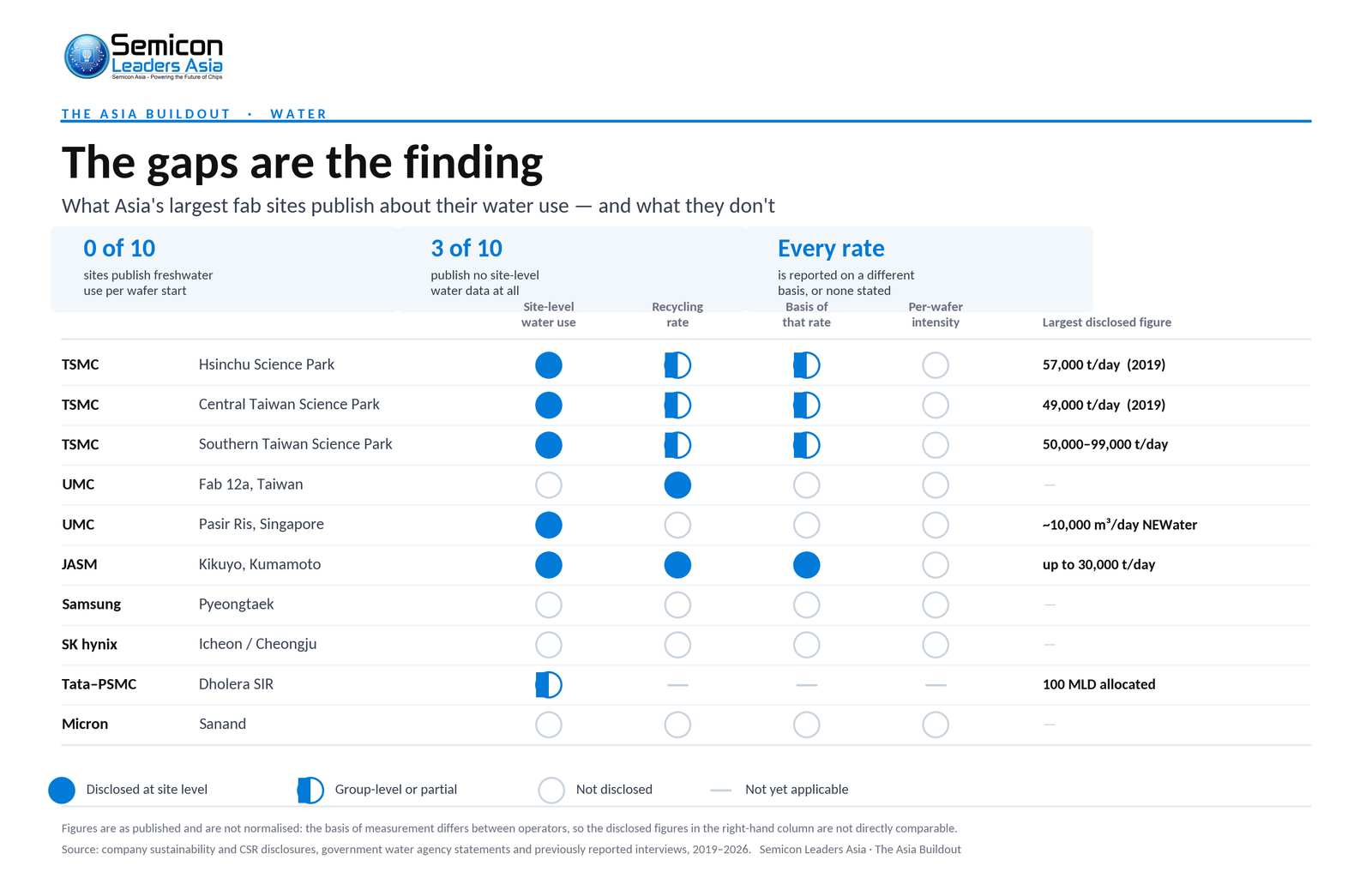
The Water Ledger, 2026
One tonne of water is treated as one cubic metre. Not disclosed means the operator does not publish the figure at site level. It does not mean the figure is zero, and it does not mean the operator is unaware of it.
|
Site / cluster
|
Operator
|
Reported water use
|
Reported recycling rate
|
Basis stated?
|
Freshwater / wafer start
|
Source & date
|
|
Hsinchu Science Park
|
TSMC
|
57,000 t/day; 10.3% of park daily supply
|
90.3% process water, company-wide
|
Process water only
|
Not derivable
|
Company CSR report, 2019; recycling rate 2023
|
|
Central Taiwan Science Park
|
TSMC
|
49,000 t/day; 3.3% of supply
|
As above, company-wide
|
Process water only
|
Not derivable
|
Company CSR report, 2019
|
|
Southern Taiwan Science Park, Tainan
|
TSMC
|
50,000 t/day (2019); reported up to 99,000 t/day (2024)
|
Reclaimed water verified for 5nm and 3nm, fully implemented at Tainan
|
Partial
|
Not derivable
|
Company reports 2019 and 2024; press reporting 2024
|
|
Fab 12a, Taiwan
|
UMC
|
Not disclosed
|
90.8% site; 84.3% company-wide
|
Not stated
|
Not derivable
|
Industry compilation, 2023 data
|
|
Pasir Ris Wafer Fab Park, Singapore
|
UMC
|
~10,000 m³/day NEWater
|
Not disclosed at site level
|
—
|
Not derivable
|
Reported interview, June 2026
|
|
JASM Fab 1, Kikuyo, Kumamoto
|
JASM (TSMC / Sony / Denso / Toyota)
|
Up to 30,000 t/day total; up to 7,500 t/day groundwater; ~2.5m t groundwater drawn in the last reported year
|
~75% target
|
Yes, groundwater separate
|
Not derivable
|
Press reporting, Dec 2025 and Jul 2026
|
|
JASM Fabs 1 + 2, from 2028
|
JASM
|
~8m t/year projected
|
~75% target
|
Yes
|
Not derivable
|
Prefectural filings; press reporting 2024–26
|
|
Pyeongtaek campus
|
Samsung
|
Not disclosed at site level
|
Not disclosed at site level
|
—
|
Not derivable
|
Company sustainability disclosure
|
|
Icheon / Cheongju
|
SK hynix
|
Not disclosed at site level
|
Not disclosed at site level
|
—
|
Not derivable
|
Company sustainability disclosure
|
|
Dholera SIR
|
Tata Electronics – PSMC
|
100 MLD allocated from Narmada; pre-production
|
Not yet applicable
|
—
|
50,000 wpm planned
|
Government statement at groundbreaking
|
|
Sanand ATMP
|
Micron
|
Not disclosed
|
Not disclosed
|
—
|
n/a — packaging
|
Company disclosure
|
Four of eleven rows are substantially empty, and two of those four cover some of the largest concentrations of water-consuming semiconductor capacity in the world. That is the ledger's principal finding.
Four clusters, four different problems
Hsinchu and Tainan: the constraint is allocation, not volume
The TSMC science-park figures above are instructive precisely because they are old. In 2019 the company disclosed that its Hsinchu operations took 10.3 percent of the park's daily supply, against 3.3 percent in central Taiwan and 5.3 percent in the south. Those proportions describe a company that was, even then, a significant but not dominant claimant on the Hsinchu catchment — and Hsinchu is the catchment under the most persistent stress.
What has changed since is not mainly consumption but supply architecture. Taiwan's answer to consecutive droughts has been redundancy: transfer pipelines, desalination plants planned for Hsinchu and Tainan, dredging programmes, drought-resistant wells. The industry's answer has been to push recycling into the high eighties and low nineties and to expand reclaimed water use. Taiwan's chipmakers now, in aggregate, use more reclaimed water than freshwater — a position no other cluster in Asia has reached.
The residual risk is consequently political rather than hydrological. When water is short, somebody decides who gets it. In 2021 that decision fell on agriculture, with irrigation halted across more than 74,000 hectares. Water in Taiwan also remains extremely cheap by international standards, muting the price signal that would otherwise moderate demand. The open question is not how much the parks use. It is what the allocation rule is when reservoirs fall below a defined threshold, who signs it, and whether that rule has changed since 2021.
Kumamoto: the replenishment depends on 74-year-olds
JASM's Kikuyo site is the most transparently reported fab in Asia on water, largely because it had to be. Kumamoto draws about eighty percent of its household water from groundwater, and the aquifer has been in decline since the 1970s as farmland was paved over.
The disclosed numbers are unusually specific. The first fab was originally planned to use 13,000 tonnes a day and was redesigned down to roughly 8,500. It pumps up to 7,500 tonnes of groundwater a day, drew about 2.5 million tonnes in the last reported year, and targets roughly seventy-five percent recycling. With the second fab, total requirement is projected at around eight million tonnes a year — about five percent of the region's annual groundwater supply.
Against that, JASM participates in a paddy-flooding recharge scheme with roots in a 2004 Kumamoto City subsidy programme, under which farmers in the Shirakawa recharge zone flood fallow fields to replenish the aquifer. Revised prefectural guidelines now require companies to restore groundwater equivalent to what they consume. TSMC has said water restored through farmer-led projects in fiscal 2025 exceeded three times what the company pumped.
On its face, an excellent result. It is also structurally fragile in a way the ratio conceals. Reporting this month found that the thirteen farmers participating in the Seta district have an average age of seventy-four, and that some question whether they can continue the physically demanding winter flooding work. A replenishment commitment underwritten by an ageing volunteer farming population is not the same class of asset as a pipeline or a desalination plant. It does not appear in any risk register as a different class of asset.
Singapore: scarcity converted into industrial policy
Singapore is the one cluster where water scarcity has been fully priced, engineered and turned into a competitive claim. UMC's Pasir Ris fab runs on roughly 10,000 cubic metres a day of NEWater — reclaimed municipal water — which it then treats to ultrapure standard. Speaking to local media in June, the site's senior fab director described the approach as segregating wastewater into separate streams rather than treating everything identically, on the basis that small efficiencies compound across a process running to around a thousand steps.
The national picture explains the emphasis. PUB expects non-domestic use to account for two-thirds of Singapore's total water demand by 2065, driven substantially by semiconductors and data centres. This year the agency secured close to S$100 million under the RIE2030 research framework, including a tranche directed specifically at industrial water solutions for wafer fabs and data centres, with an integrated validation plant for energy-positive used-water treatment due in 2027. UMC is meanwhile bringing a new Singapore fab into volume production this year, taking island capacity past a million wafers annually.
The instructive point for other clusters is that Singapore treats reclaimed water as the default industrial input rather than a drought contingency. That inverts the accounting: a Singapore fab's freshwater withdrawal can be structurally low while its total water consumption is not low at all.
Korea: the constraint is invisible
Korea is where the ledger fails. Samsung and SK hynix operate some of the world's largest concentrations of water-consuming semiconductor capacity, at Pyeongtaek, Hwaseong, Icheon and Cheongju, and neither publishes withdrawal or recycling at site level in a form permitting comparison. Samsung has disclosed a company-level reduction of about 16.76 million tonnes across its Korean sites in 2024, and has previously said daily withdrawal for its Korean semiconductor operations is projected to double as capacity expands. Both are meaningful disclosures. Neither is a site figure, and neither can be set honestly alongside JASM's 7,500 tonnes a day.
This matters more this year than last, because the scale of what is coming is now official. Under a national plan announced in June, Samsung and SK hynix are to invest a combined 800 trillion won in four new fabs in the country's south-west, with a further 81 trillion won for packaging in Chungcheong, and the government aims to double national DRAM capacity within five years. Samsung is to build P5 and P6 at Pyeongtaek simultaneously. SK hynix's Yongin programme is to be accelerated by twelve years against its original schedule. The plan addresses water in a single provision: supply will be strengthened by completing an integrated water supply project ahead of schedule and by increasing recycling.
A twelve-year compression is extraordinary. The water infrastructure serving it either arrives on the same compressed timetable or it does not, and there is no published site-level baseline against which anyone outside the two companies can judge which.
What a recycling percentage actually measures
The headline number is the least informative part of any water disclosure, for three reasons worth separating.
A recycling rate is a ratio, not a volume. A site can raise its recycling percentage while increasing total freshwater withdrawal, simply by growing. If output doubles and recycling improves from eighty to ninety percent, more water still leaves the catchment. The percentage measures process efficiency. It does not measure impact on the surrounding water body, and it is routinely presented as though it did.
The boundary is elastic. Water cascading from ultrapure wafer rinsing down through chemical mechanical planarisation, then to scrubbers, then to cooling towers and landscape irrigation is being reused, and every stage can legitimately be counted. Whether the cooling stage sits inside or outside the reported denominator moves the headline figure substantially. Two operators making genuinely different choices can report near-identical percentages.
Recycling and replenishment answer different questions. A fab recycling ninety percent of its process water in a stressed catchment remains a net extractor. A fab recycling seventy-five percent while restoring more groundwater than it pumps has a different relationship with its aquifer entirely. The first will usually screen better on an ESG scorecard, because the scorecard reads the percentage.
The figure that would answer the question people actually mean to ask — how much freshwater leaves this catchment per unit of production — is the one nobody publishes.
The next five years
Set announced demand against announced supply and the picture is uneven in a specific way.
Taiwan is adding capacity into a catchment that has had two severe droughts in five years, and is answering with hard infrastructure on a timetable the Water Resources Agency says it is accelerating. The industry is close to the practical ceiling of what recycling can deliver; incremental gains from here are small and expensive. Supply-side engineering is doing the work.
Japan brings a second Kumamoto fab into operation from late 2027, roughly tripling JASM's site draw, against a replenishment mechanism dependent on the continued participation of elderly farmers and on a prefectural requirement whose enforcement machinery has not been publicly tested.
Singapore is expanding into a system that anticipated this and is spending public research money to stay ahead of it, with non-domestic demand projected to reach two-thirds of national consumption by 2065.
Korea is committing to the largest single capacity expansion in the industry's history on a compressed schedule, with water addressed in one sentence of the national plan and no published site-level baseline.
India is building a 50,000-wafer-per-month fab in a semi-arid district on a 100 million litre per day allocation from the Narmada canal system — the same system supplying metropolitan Ahmedabad through the summer. A long-term supply agreement exists. Whether it holds in a drought year is untested, and the project's own schedule has already moved, with trade reporting this month indicating a slip toward 2028 and a change in the opening process node.
None of this predicts failure. Every cluster has a plausible plan. The purpose of a ledger is narrower and more durable than prediction: it records, in one place and on one basis, what each operator said it would draw and give back, on a date, so that in three years somebody can check.
Which is why the empty cells matter. A company that does not publish a site-level figure is not necessarily doing anything wrong. It is, however, making it impossible for anyone outside the company to know whether the water plan and the capacity plan were ever reconciled.
Methodology
This analysis is compiled from published corporate sustainability and CSR disclosures, government water agency statements and filings, and interviews previously reported by other outlets, each attributed in the text. No figure in the ledger originates with Semicon Leaders Asia; every figure is traceable to a dated public source, listed below. Where an operator publishes only at group level, the ledger records the site cell as not disclosed rather than substituting the group figure. Freshwater intensity per wafer start is marked not derivable wherever site-level wafer starts are unpublished, which is nearly everywhere. Tonnes and cubic metres are treated as equivalent. Figures are as published and have not been restated.
This table will be republished annually. Operators wishing to supply site-level withdrawal and recycling data, with the basis stated, can write to sandy@semiconleadersasia.com. Submissions will be published with attribution and a date. Corrections to any cell are welcome on the same terms.
Sources
Taiwan Water Resources Agency statements, March and June 2026. TSMC Corporate Social Responsibility Report 2019, science park consumption tables. TSMC Sustainability Report 2024, recycled water volumes and reclaimed water verification. Published industry compilation of 2023 process water recycling rates for TSMC and UMC. Japanese press reporting, November 2024 and December 2025, on JASM groundwater draw and the Kumamoto recharge programme. Regional press reporting, July 2026, on Kumamoto participation and fiscal 2025 restoration ratios. Frontiers in Environmental Science, 2019, on the Kumamoto paddy subsidy scheme. Reported interview with UMC Singapore, June 2026. PUB and Singapore International Water Week funding announcements, June 2026. Samsung sustainability disclosure on Korean site water reduction. Korean trade press, June 2026, on the national semiconductor investment plan. Indian government statements at the Dholera groundbreaking; trade reporting, July 2026, on schedule and node revisions. Published benchmark freshwater-to-ultrapure-water ratios from industry analysis.
Part of The Asia Buildout, a Semicon Leaders Asia series on the physical constraints — water, power, packaging, chemistry, metrology and people — on building semiconductor capacity in Asia.