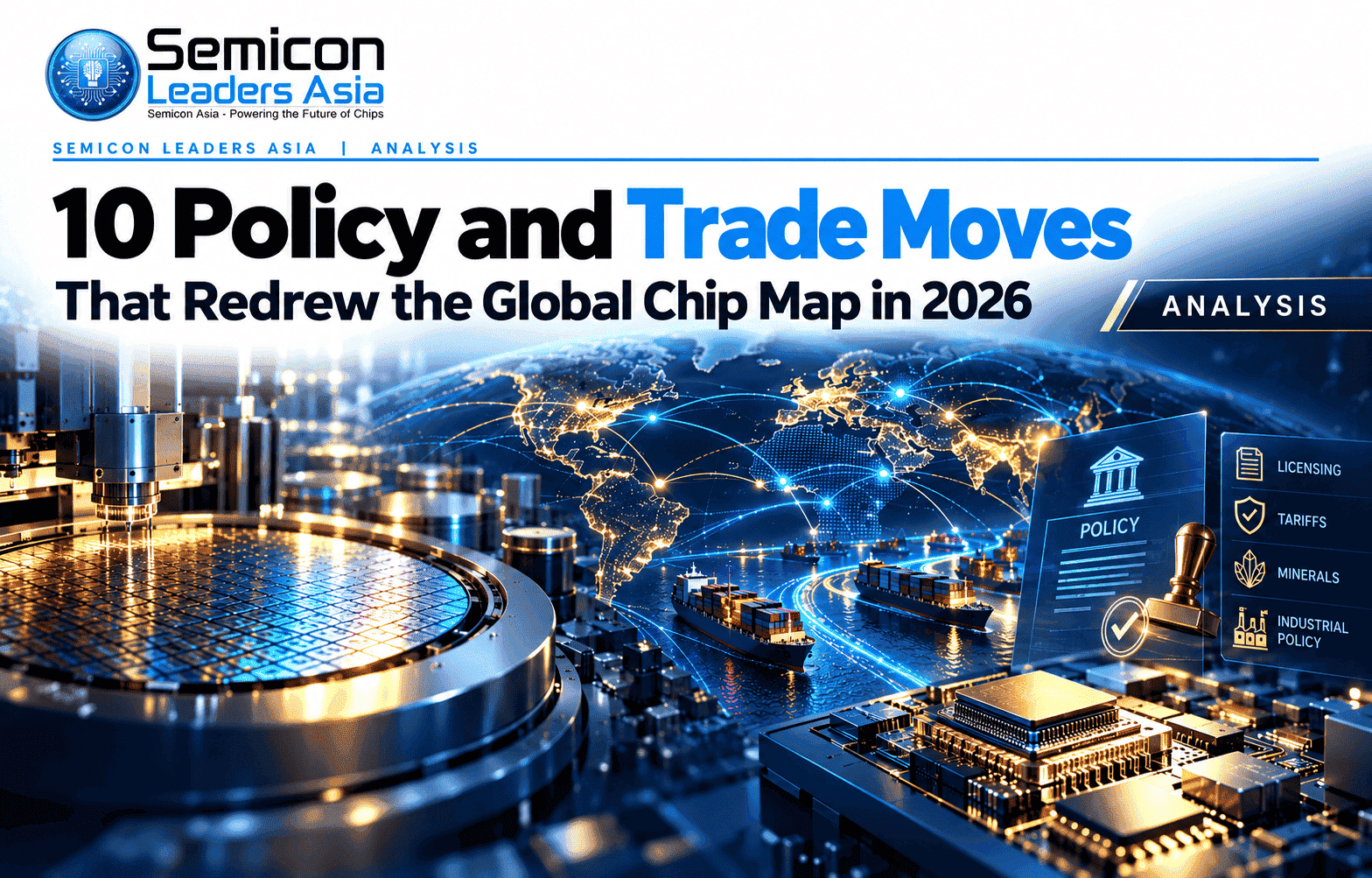
10 Policy and Trade Moves That Redrew the Global Chip Map in 2026
14 October 2026 |
Analysis
Export licences, tariffs, minerals enforcement and industrial subsidies did more than move regulatory lines this year. They decided where chipmakers invest, which suppliers buyers can actually use, and what has to be locked down before 2027 purchase orders go out.
KEY TAKEAWAYS
- Governments spent 2026 managing flows rather than stopping them: licences with conditions, tariffs with carve-outs, minerals rules backed by enforcement.
- Industrial policy moved beyond the fab into packaging, materials, equipment, design and talent, from New Delhi to Brussels to Seoul.
- For buyers, available capacity and accessible capacity are no longer the same thing. Compliance now sits inside capacity planning.
In 2026, governments became some of the semiconductor industry's most influential capacity planners.
Washington reopened a narrow, heavily conditioned route for advanced AI processors into China, and in the same week wrapped those chips inside a new Section 232 tariff. Taiwan traded tariff certainty for a US$500 billion investment and credit commitment. Japan tightened its technology controls even as it became a shareholder in Rapidus. Brussels began rewriting the Chips Act. Beijing turned its strategic-mineral controls into an enforcement drive backed by public reporting. Seoul answered with sheer scale, and New Delhi widened its chip programme well beyond the fab.
Taken one at a time, each looks like a political headline. Taken together, they describe a supply chain in which a licensing condition in Washington can shape foundry allocation in Hsinchu, a Chinese minerals rule can stall an equipment build in Japan or Europe, and a tariff carve-out can decide where a supplier puts its next warehouse, service centre or packaging line.
So the useful question for 2027 is not which policy made the most noise. It is three simpler ones, and we put them to every move below: what changed, who pays, and what it does to next year's orders.
The 2026 policy map at a glance
|
Date
|
Policy or trade move
|
Main supply-chain exposure
|
What it changes for 2027
|
|
13 Jan
|
US reopens a conditional licence route for AI chips to China and Macau
|
Accelerator vendors, foundries, distributors, Chinese buyers
|
China-bound supply becomes licence and allocation dependent
|
|
14 Jan
|
US imposes a 25% Section 232 tariff on advanced computing chips
|
Importers, chip vendors, system builders
|
Tariff exposure enters sourcing and contract negotiation
|
|
14 Jan / 14 Feb
|
Japan widens sensitive-technology and export controls
|
Equipment, component and technology suppliers
|
Regulatory lead time joins manufacturing lead time
|
|
15 Jan
|
US and Taiwan sign tariff and investment agreement
|
Taiwanese fabs and their equipment and materials suppliers
|
More supply-chain capacity follows customers to the US
|
|
27 Feb / 5 Jun
|
Japan takes direct equity in Rapidus
|
Equipment, materials, EDA, IP and packaging suppliers
|
Orders hinge on Rapidus's 2nm ramp
|
|
24 Mar
|
Netherlands withdraws general export licence NL900
|
Dutch technology exporters and advanced fabs
|
Authorisation timing enters installation schedules
|
|
3 Jun
|
European Commission proposes Chips Act 2.0
|
Fabs, packaging, equipment suppliers, member states
|
European support widens across the value chain and into demand
|
|
24 Jun
|
China turns strategic-mineral controls into an enforcement drive
|
Materials buyers, traders, forwarders, equipment firms
|
Alternative sourcing and buffer stock gain weight
|
|
29 Jun / 14 Jul
|
South Korea commits to double memory capacity in five years
|
Memory makers, equipment vendors, utilities, infrastructure
|
A large memory, HBM and fab investment pipeline
|
|
15 Jul
|
India approves Semicon 2.0
|
Equipment, materials, packaging, design and fabs
|
Orders move from single plants to ecosystem build-out
|
The table shows how far semiconductor policy has travelled beyond the old choice between subsidy and restriction. Licences now interact with capacity allocation. Tariffs interact with investment pledges. Minerals rules reach logistics and financing. And industrial policy increasingly covers packaging, materials, equipment and talent rather than the fab alone.
In practical terms, regulation has become part of the bill of materials.
1. 13 January: Washington reopens a narrow road for AI chips into China
What changed
The US Bureau of Industry and Security (BIS) announced a revised licence review policy for certain advanced processors bound for China and Macau, published as a final rule effective 15 January. Applications covering Nvidia's H200, AMD's MI325X and comparable chips below defined performance thresholds moved from a presumption of denial to case-by-case review. The conditions are demanding: applicants must show that China-bound sales will not reduce supply or foundry capacity available to US customers, document compliance procedures at the Chinese customer, and put the chips through independent testing in the United States. Industry analyses of the rule also describe a ceiling that ties China volumes to US shipments.
Who pays
The direct compliance load sits with chip vendors and exporters, but the rule reaches further. Foundries are drawn into the calculation because suppliers must prove that China-bound production does not crowd out US customers. And because testing happens on US soil, the chips are imported first, which brings them into contact with the tariff in move 2. Chinese buyers gain a possible route to hardware, but not certainty of volume.
What it does to 2027 orders
China-facing procurement becomes a portfolio decision. Buyers have reason to qualify imported accelerators where licences come through while continuing to build domestic alternatives. US vendors can win back business, but cannot assume a China order turns automatically into a shipment.
2. 14 January: A Section 232 tariff adds a second policy layer
What changed
A presidential proclamation imposed a 25% Section 232 tariff on specified advanced computing chips, including H200 and MI325X-class parts, and certain derivative products, effective from 12:01 a.m. on 15 January. The duty does not apply to chips used in the US for data centres, research and development, or repairs and replacements, or to imports that Commerce judges to strengthen the US technology supply chain. No duty drawback is available. The proclamation also keeps the door open to broader tariffs on semiconductors, equipment and derivative products, paired with an offset programme that would reward companies investing in US production.
Who pays
Importers carry the immediate exposure, but suppliers now face a location decision as well. Because treatment turns on end use, the landed cost of a chip increasingly depends on what it is for and where the surrounding investment sits.
What it does to 2027 orders
Long-term supply contracts need more than a wafer price. Expect tariff-adjustment clauses, origin provisions and end-use documentation to become standard. Read moves 1 and 2 together and the design is clear: Washington is not choosing between open and closed, it is pricing and conditioning access. Semiconductor sourcing has become partly a customs exercise.
3. 14 January and 14 February: Japan widens its sensitive-technology perimeter
What changed
Japan brought additional technology-management measures into force on 14 January, followed on 14 February by revisions to the goods controlled under its Export Trade Control Order. The February changes added modules, assemblies and components containing certain field-programmable logic devices, alongside other internationally agreed controlled items.
Who pays
Japanese suppliers take on more classification and licensing work. Overseas customers absorb part of that burden through longer qualification cycles and shipment planning, especially where a product bundles hardware, software and technical support.
What it does to 2027 orders
Customers buying sensitive Japanese technology now have to plan for regulatory lead time alongside manufacturing lead time. Spare parts, field support and second sources climb the purchasing checklist.
4. 15 January: Taiwan trades tariff certainty for deeper US investment
What changed
The US and Taiwan signed a trade and investment agreement that caps the reciprocal tariff on Taiwanese goods at 15%, down from 20%, without additional MFN stacking. Future Section 232 duties on semiconductors are set to favour Taiwanese producers that build in the United States, with tariff-free import allowances linked to that new capacity. In return, Taiwanese chip and technology companies are to make at least US$250 billion in direct US investment, backed by at least another US$250 billion in government-supported credit guarantees for the wider supplier base.
Who pays
The price of certainty is capital intensity. Taiwanese manufacturers gain tariff visibility, but semiconductor expansion becomes even more geographically spread, and equipment, materials and service firms have to follow their customers into a costlier US operating environment. The credit-guarantee half of the package is aimed squarely at those smaller suppliers.
What it does to 2027 orders
More Taiwanese supply-chain spending moves with the fabs. Equipment makers, chemical suppliers, facilities contractors and packaging companies that want to stay close to anchor customers will need US footprints of their own.
5. 27 February and 5 June: Japan becomes a shareholder in the Rapidus bet
What changed
By 27 February, the Japanese government and private companies had put ¥267.6 billion into Rapidus: ¥100 billion through the state-backed Information-technology Promotion Agency (IPA) and ¥167.6 billion from 32 companies including Canon, Fujitsu, NTT, SoftBank and Sony Group. On 5 June the government added a further ¥150 billion through IPA, lifting Rapidus's capital to about ¥425 billion. METI said the new money would fund equipment for 2nm mass production and research on 1.4nm, with mass production targeted for Japan's 2027 fiscal year.
Who pays
Japan is moving part of the Rapidus risk directly onto the public balance sheet, with further subsidies planned on top. For suppliers, the distinction that still matters is the gap between funded construction and sustainable foundry demand.
What it does to 2027 orders
Rapidus has to place equipment, materials, IP and production-support orders before customer volume is fully proven. That is a real opportunity for suppliers, but one tied closely to pilot-line yield, customer commitments and the 2nm production timetable.
6. 24 March: The Netherlands tightens its export-licensing machinery
What changed
A Dutch ministerial order published on 24 March formally withdrew National General Export Authorisation NL900. Introduced in 2024, NL900 had let exporters ship nationally controlled emerging-technology items to a short list of allied destinations, including the US, Japan and the UK, after a one-off customs registration. Without it, those shipments fall back on global or individual licences. The broader Dutch system for advanced semiconductor manufacturing equipment still rests on case-by-case authorisation rather than a blanket ban.
Who pays
The burden falls most heavily on exporters and customers whose shipments now need individual regulatory treatment. A purchase order for advanced Dutch equipment is no longer the same thing as certainty of export, even to friendly destinations.
What it does to 2027 orders
Fabs buying Dutch tools need licence timing built into installation schedules. For customers in higher-risk destinations, service, replacement parts and future upgrades have to be weighed alongside the original tool purchase.
7. 3 June: Europe starts writing Chips Act 2.0
What changed
The European Commission proposed Chips Act 2.0, a new regulation that would repeal and replace the 2023 Chips Act. The first Act helped mobilise more than €52 billion in public and private investment; the sequel aims to reduce strategic dependencies, reinforce Europe's strength in mainstream chips and build leading-edge capacity. The notable shift is towards demand: the proposal ties European chip production to demand from data centres, cloud providers and AI gigafactories, alongside the companion Cloud and AI Development Act. It now moves through negotiation between the European Parliament and the Council.
Who pays
Member states and industry still have to turn ambition into competitive projects. That means public funding, private capital and a continuing need to justify why capacity belongs in Europe rather than in lower-cost Asian clusters.
What it does to 2027 orders
The opportunity widens beyond front-end fab equipment into advanced packaging, chiplet integration, design infrastructure and supporting supply chains. Because the text is still being negotiated, 2027 is more likely to bring positioning and pilot projects than final purchase orders.
8. 24 June: China makes strategic-mineral controls an enforcement issue
What changed
China's Ministry of Commerce issued Announcement No. 26, effective 1 July, formalising how violations of strategic-mineral dual-use export controls are reported and handled. It gives any organisation or individual the right to report suspected breaches, including unlicensed shipments, exports outside a licence's scope, conditions or validity, exports of prohibited items and circumvention. It also covers accepting foreign-government requests for on-site verification without authorisation.
Who pays
The compliance burden extends well beyond miners. Traders, freight forwarders, intermediaries and overseas customers all now operate in a system where employees, competitors and logistics partners are potential informants. Know-your-customer and end-use checks on mineral orders become non-negotiable.
What it does to 2027 orders
Critical minerals become a contracting issue. Chipmakers and equipment suppliers have stronger reasons to hold more inventory, qualify alternative processors and trace where upstream materials are refined, not just where they are bought.
9. 29 June and 14 July: South Korea responds with scale
What changed
At a presidential briefing on 29 June, Samsung Electronics and SK hynix set out plans to build two memory fabs each in the south-west, around Gwangju, with combined investment of ₩800 trillion (roughly US$518 billion), plus ₩81 trillion for an HBM and advanced packaging hub in South Chungcheong. The stated goal is to double Korea's DRAM production capacity within five years, with the government pledging more than ₩30 trillion over 15 years for next-generation chips. On 14 July, the government wrote the plan into its second-half Economic Growth Strategy, alongside fast-tracking fabs at Yongin and Pyeongtaek.
Who pays
Samsung, SK hynix and the wider Korean supply base carry most of the investment, while the state has to deliver the land, power, water, permits and R&D support around it. Markets flagged the risk on day one: both companies' shares slipped as some analysts warned that capacity built for a shortage can arrive in time for a glut.
What it does to 2027 orders
Expect another equipment and infrastructure cycle, shaped heavily by memory and AI. Suppliers exposed to HBM, DRAM, advanced packaging, power and fab infrastructure have the clearest route into new orders, provided construction timelines firm up.
10. 15 July: India turns semiconductor incentives into ecosystem policy
What changed
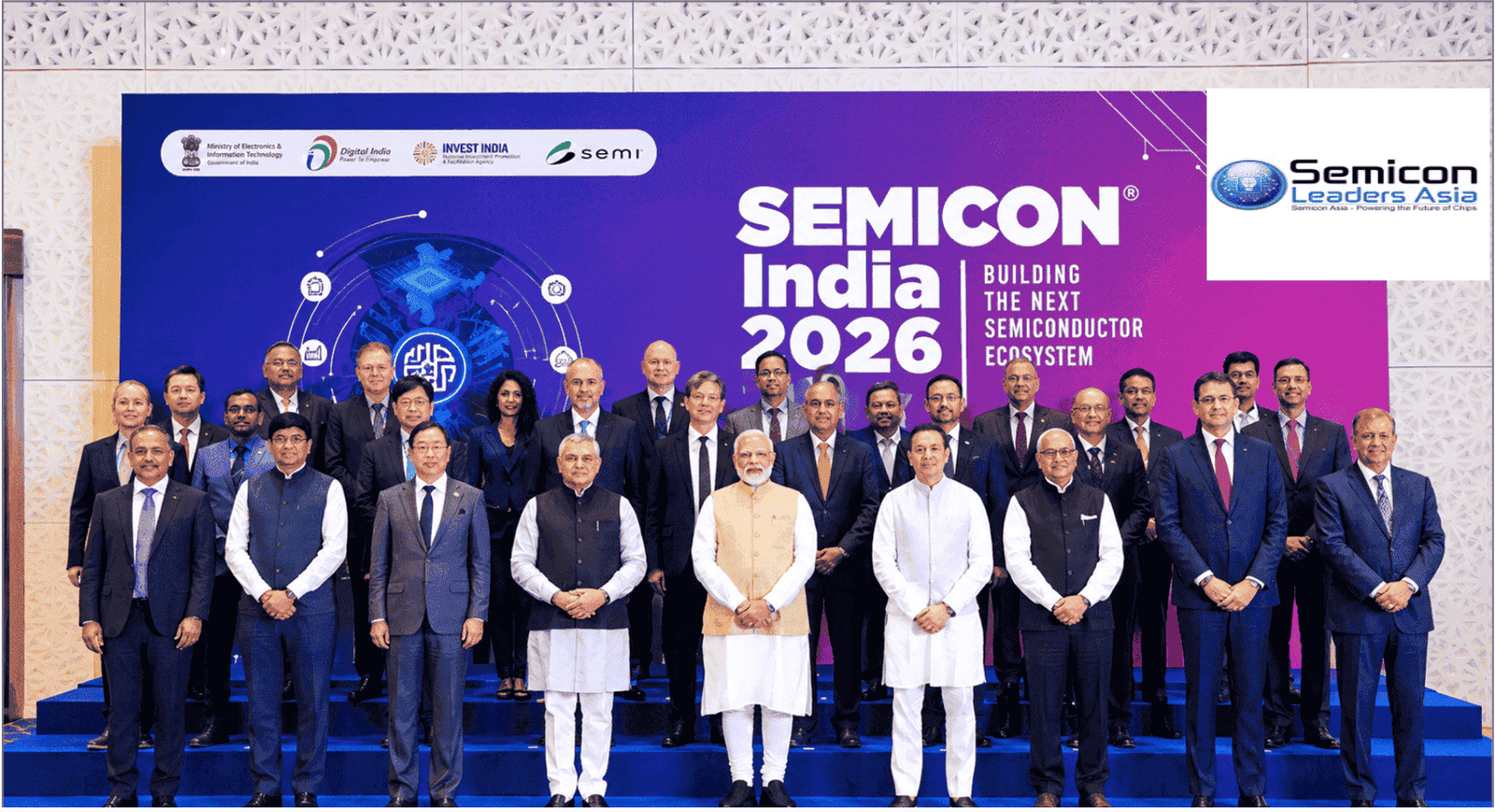
India's Union Cabinet approved Semicon 2.0 with an outlay of ₹1,27,500 crore (about US$13 billion). Its six pillars cover chip design, semiconductor machines and materials, new fabs, assembly, test and packaging, research and development, and talent. It builds on the ₹76,000 crore first phase, under which 12 manufacturing units with cumulative investment of more than ₹1.64 lakh crore were approved: a silicon fab, a silicon carbide fab, a gallium nitride micro-LED display fab and nine packaging units. Three of them, at Micron, Kaynes and CG Semi, had already begun commercial production.
Who pays
Government support gets wider, but suppliers face a tougher localisation question. Selling an imported machine into a subsidised fab is one thing; establishing service, materials, manufacturing or design capability around it is another.
What it does to 2027 orders
India's procurement story moves into the spaces between its headline projects. Equipment service, specialty materials, packaging tools, test systems, substrates and design infrastructure gain importance as the first wave of plants ramps.
What procurement teams need to carry into 2027
Every move above leaves a question that belongs on the desk before a purchase order is signed. The third column shows where each risk came from this year.
|
Risk
|
Question before the purchase order
|
Traced to
|
|
Export licence
|
Can the product, technology and associated service legally reach the customer?
|
Moves 1, 3, 6
|
|
Tariff exposure
|
Is the quoted price protected if Section 232 or another duty changes?
|
Moves 2, 4
|
|
End use
|
Does regulatory treatment depend on how the chip or tool will be used?
|
Moves 1, 2
|
|
Foundry allocation
|
Does a licence or policy condition affect wafer availability?
|
Moves 1, 4
|
|
Materials
|
Does any critical input depend on controlled Chinese processing or export approval?
|
Move 8
|
|
Tool servicing
|
Can software, spare parts and engineers keep supporting the equipment?
|
Moves 3, 6
|
|
Localisation
|
Does subsidy eligibility favour local manufacturing, suppliers or investment?
|
Moves 4, 7, 10
|
|
Packaging
|
Is back-end capacity available in the same geography as the wafers?
|
Moves 9, 10
|
|
Inventory
|
Should long lead-time or controlled materials be stocked ahead of demand?
|
Moves 3, 8
|
|
Contract terms
|
Who carries the cost if tariffs, licences or export rules change after signing?
|
Moves 2, 4, 8
|
The Semicon Leaders Asia view
Read together, the ten moves point to three shifts in how semiconductor policy works.
1. Governments are managing flows, not simply stopping them
The US AI-chip regime does not just permit or prohibit exports; it attaches conditions on customer access, testing and manufacturing capacity. Tariffs vary by end use. Dutch controls run on authorisations rather than a blanket ban. China's mineral system works through licensing and, now, active enforcement. The result is a market in which a product can be commercially available yet not equally accessible to every customer.
2. Industrial policy is moving beyond the fab
India's six pillars span equipment, materials, packaging, design and talent. Europe's second Chips Act reaches into demand. Korea is pairing fab scale with packaging and next-generation R&D. Taiwan's model pulls an entire supplier ecosystem towards new geography. The fab still matters, but governments increasingly understand that subsidising a cleanroom without the surrounding supply chain only relocates dependence.
3. Compliance is becoming part of capacity planning
This may be the biggest change for business. A licence can delay an accelerator shipment. A tariff can change landed cost after a contract is signed. A minerals rule can hold up an equipment maker several tiers downstream. A brand-new fab can still depend on tools that need government permission to cross a border.
For procurement teams, that means available capacity and accessible capacity are no longer the same thing.
What to watch in 2027
- Washington: whether the broader Section 232 tariff on semiconductors and equipment, with its investment offset, actually arrives, and how many China licences BIS really grants.
- Brussels: the European Parliament and Council positions on Chips Act 2.0, and how much of the demand-side toolkit survives.
- Hokkaido: whether Rapidus holds its 2nm mass-production timetable and signs anchor customers.
- Seoul: firm construction schedules for the south-west fabs, and whether memory pricing supports them.
- New Delhi: Semicon 2.0 scheme guidelines and the first approvals under the new pillars.
- Beijing: the first published enforcement cases under Announcement No. 26.
The global chip map, in the end, is not being redrawn only by where fabs are built. It is being redrawn by the conditions attached to the wafers, tools, materials, technology and capital that feed them.
For 2027, the strongest purchasing position may not belong to the customer willing to pay the most. It may belong to the one that already knows which supply is legally accessible, which alternatives are qualified, and which contracts still work when the next rule changes.
Capacity that can legally ship matters more than capacity that merely exists.
Sources
- US Bureau of Industry and Security, revised licence review policy for semiconductors exported to China, January 2026: https://www.bis.gov/press-release/department-commerce-revises-license-review-policy-semiconductors-exported-china
- The White House, proclamation on adjusting imports of semiconductors, semiconductor manufacturing equipment and their derivative products, 14 January 2026: https://www.whitehouse.gov/presidential-actions/2026/01/adjusting-imports-of-semiconductors-semiconductor-manufacturing-equipment-and-their-derivative-products-into-the-united-states/
- Japan Ministry of Economy, Trade and Industry, export-control amendments: https://www.meti.go.jp/english/press/2025/1111_004.html
- Taiwan Executive Yuan, US-Taiwan trade and investment agreement: https://english.ey.gov.tw/Page/61BF20C3E89B856/e5112206-4256-449b-9b8c-8fcb3d2daf61
- Japan Ministry of Economy, Trade and Industry, press conference on Rapidus, 27 February 2026; Rapidus Corporation funding announcement, 5 June 2026: https://www.meti.go.jp/english/speeches/press_conferences/2026/0227001.html
- Netherlands Staatscourant 2026, 11107 (withdrawal of NL900): https://zoek.officielebekendmakingen.nl/stcrt-2026-11107
- European Commission, Proposal for the Chips Act 2.0, 3 June 2026: https://digital-strategy.ec.europa.eu/en/library/proposal-chips-act-20
- Ministry of Commerce of the People's Republic of China, Announcement No. 26 of 2026: https://exportcontrol.mofcom.gov.cn/article/zcfg/gnzcfg/zcfggzqd/202606/1299.html
- Republic of Korea Ministry of Economy and Finance, Economic Growth Strategy for the Second Half of 2026, 14 July 2026: https://english.mofe.go.kr/
- Government of India, Press Information Bureau, Cabinet approves Semicon 2.0, 15 July 2026: https://www.pib.gov.in/PressReleasePage.aspx?PRID=2284796